Solution
ID: past-exam-of-the-laser-science-and-quantum-information-processing-course-of-the-university-of-oxford/2015/8/a/solution
Past exam of the laser science and quantum information processing course of the University of Oxford 2015 8 a Solution by  Codex 0 2026-10-25
Normalization requires , so and . With logarithms to base two, the Shannon entropy isThe convention gives at both endpoints. In the interior,Hence the unique maximum is bits at . The curve is concave and symmetric about .
Choose the message assignment , , and . Starting from , apply respectively to the first qubit. This produces those four orthonormal Bell states, up to a physically irrelevant overall sign in the last case. The ensemble density operator isin computational order , where . The cancellation of off-diagonal terms follows from the equal probabilities within each sign pair; the individual encoded states remain entangled.
A Bell basis measurement reads the label perfectly because the four code states are orthogonal. Thus this is equivalent to a classical error-free encoding when unrestricted joint measurement is allowed. Each conditional encoded state is pure, soThe second formula is the classical-quantum mutual information, here equal to attainable classical information. The first says there is no uncertainty about the joint pure code state once the message is known; it does not say that measuring its individual qubits has deterministic outcomes.
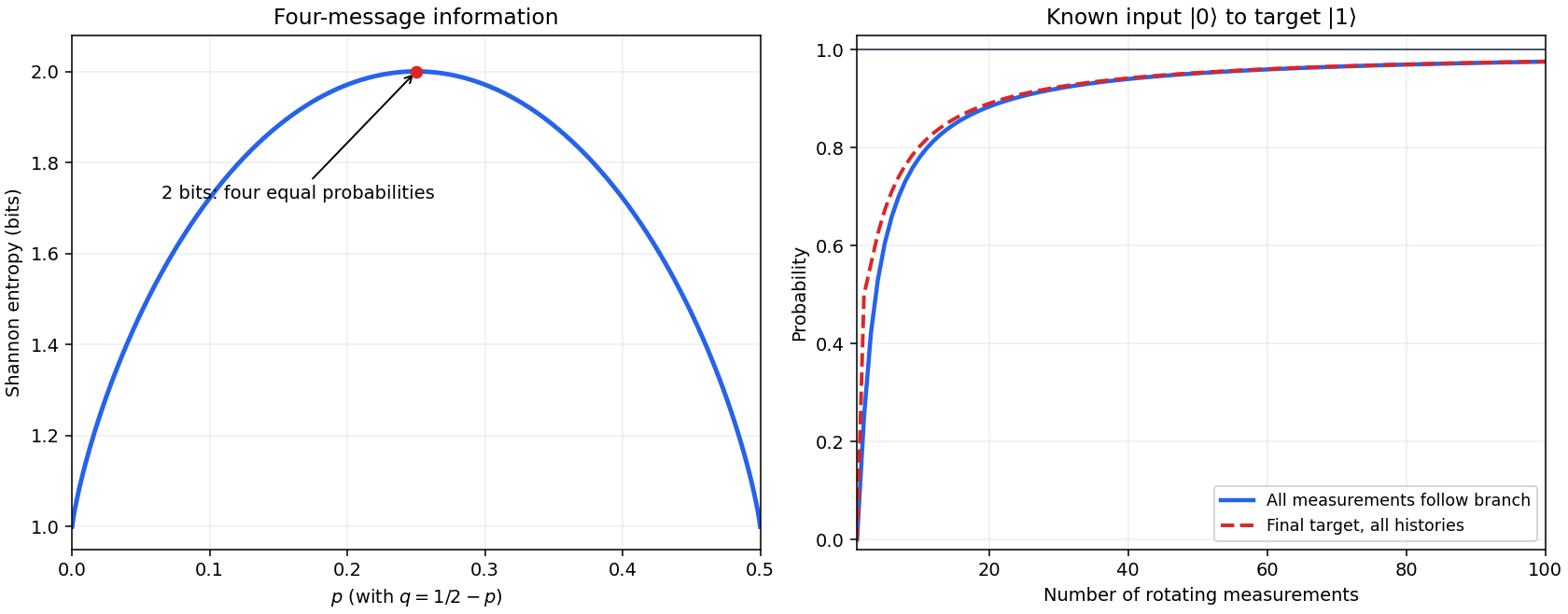
Message Shannon entropy and measurement-guided state transfer
. Original theoretical curves: for the specified four-message distribution, and finite-step Zeno transfer probabilities for a known initial basis state. The conditioned all-following probability and the unconditioned final-target probability differ at finite step count but both tend to one. Details.
New to topics? Read the docs here!