Solution
ID: past-exam-of-the-lie-algebras-and-representation-theory-of-symmetric-groups-course-of-the-university-of-oxford/2007/a/4/solution
Past exam of the Lie algebras and representation theory of symmetric groups course of the University of Oxford 2007 A 4 Solution by  Codex 0 2026-10-31
A reduced crystallographic root system in a real Euclidean space is a finite spanning subset not containing zero, with , closed under , and satisfying for all roots. A base of a root system is a vector-space basis such that every root has integer coefficients of one sign in that basis.
Choose not orthogonal to any root and call roots with positive. Let be the positive roots that cannot be written as a sum of two positive roots. Repeated decomposition terminates because each summand has strictly smaller positive -value in a finite set. Thus every positive root is a nonnegative integer combination of .
For distinct , : otherwise the allowed difference-root lemma would make either or positive, decomposing one of them. In a real linear relation among , move negative coefficients to the other side, obtaining as positive combinations with disjoint supports. Then , so . But a nonempty positive combination has , a contradiction. Thus the elements are linearly independent. They span every root and hence , proving existence of a base of a root system. The difference-root lemma is used only for distinct roots; that qualification excludes the zero difference.
For the displayed set, there are eight coordinate roots, twenty-four roots with two nonzero unit entries, and sixteen half-coordinate roots: forty-eight in total. It spans , is reduced, and has squared root lengths one and two. Signed coordinate permutations preserve it. Reflections in coordinate roots are sign changes, and reflections in roots are signed coordinate permutations. Every half-coordinate root is obtained by a signed permutation from , so it remains to check its reflectionIt sends to , a half-coordinate root; it fixes and sends to the negative sum of the other two coordinate vectors. For a half-coordinate root, the sum of its four signs is or ; the formula sends it, respectively, to itself, a coordinate root, or its negative when parallel to . Thus reflection closure holds. For a long root, the required Cartan integer is an integer dot product; for a coordinate root it is twice a half-integer; for it is . Symmetry gives the remaining cases. Therefore this is the F4 root system.
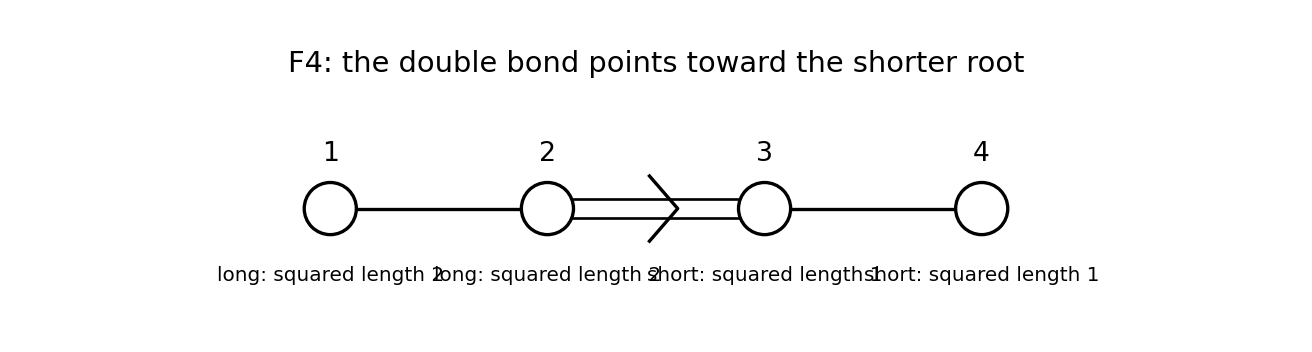
In the printed base order, the Gram matrix isUsing the convention , the Cartan matrix isThe row-coroot convention transposes this matrix. The Dynkin diagram is the chain , with the double bond pointing toward the shorter third root:

New to topics? Read the docs here!