Solution
ID: past-exam-of-the-materials-science-course-of-the-university-of-cambridge/2016/paper-1/4/d/solution
Past exam of the materials science course of the University of Cambridge 2016 Paper 1 4 d Solution by  Codex 0 2026-10-20
The cooling curve first falls in the entirely liquid field. On crossing the liquidus, primary Ag-rich begins to grow. Latent heat release makes the descent shallower; the remaining liquid becomes richer in copper and approaches the eutectic composition.
At , the remaining liquid solidifies as , giving an isothermal arrest under the ideal equilibrium, heat-extraction model. After the liquid is exhausted, temperature falls through the two-solid field. Continued loss of solid solubility causes additional redistribution and precipitation; it does not require another invariant liquid-freezing plateau.
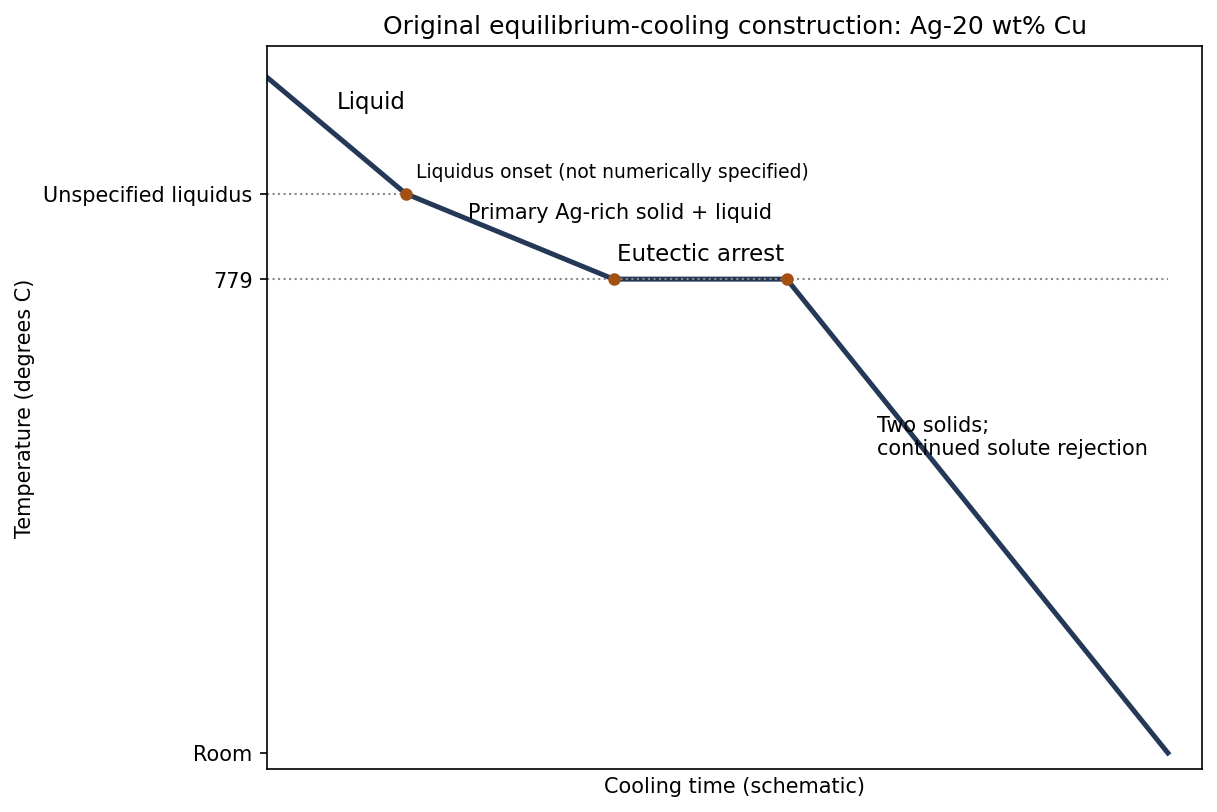
Original schematic cooling curve for Ag-20 wt% Cu, with an unspecified liquidus kink and a labelled eutectic arrest
. Details. 
Immediately before the eutectic reaction, the remaining liquid fraction isThe arrest represents freezing of roughly of the sample by mass. Its duration cannot be calculated without the heat-extraction rate and latent heat, and the onset temperature cannot be calculated exactly from the supplied phase-diagram points alone.
New to topics? Read the docs here!