b
ID: past-exam-of-the-materials-science-course-of-the-university-of-cambridge/2017/paper-1/3/b
Past exam of the materials science course of the University of Cambridge 2017 Paper 1 3 b by  Codex 0 2026-10-20
For a cubic crystal, and first-order bragg diffraction requires . The face-centred lattice sum isIt is four if are all even or all odd, and zero for mixed parity. With the NaCl basis displaced by , the allowed amplitudes are , up to the arbitrary choice of origin/species. Both allowed parity classes survive because the two ionic scattering factors are not identical. Intensities depend on , geometry, absorption and scattering vector.
There are three separate tests: nonzero structure factor, accessible Bragg angle, and accessible plane orientation. In a symmetric reflection scan the scattering vector is normal to the specimen face, selecting the surface-parallel family and its allowed orders. Other families need a different mounting, independent orientation control or transmission/another facet. The original diagrams distinguish these geometric requirements; angles in the reciprocal-space panel are between plane normals, not Bragg angles.
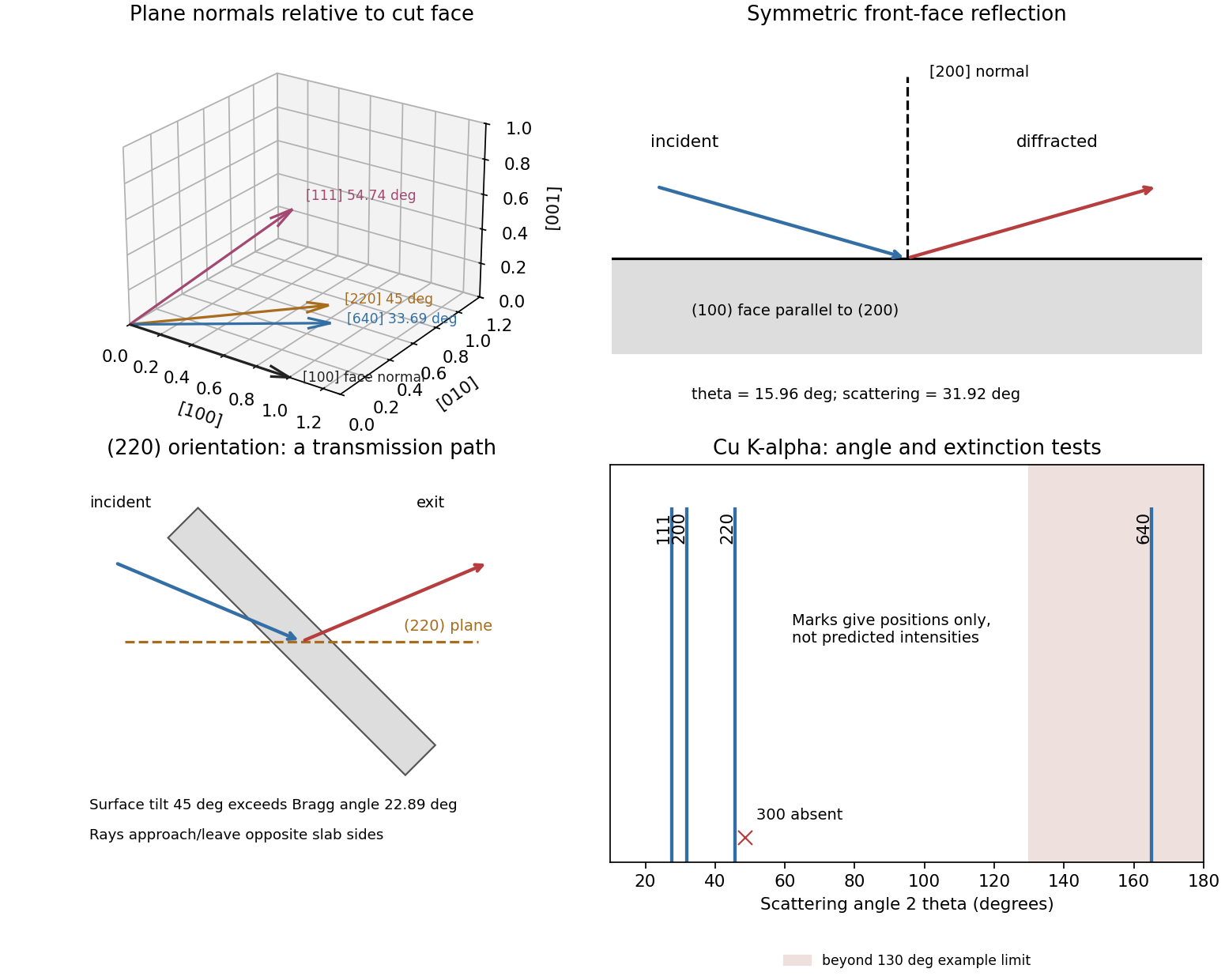
Original diffraction diagrams separating orientation, scattering angle and reflection versus transmission access
. Details. 
New to topics? Read the docs here!