For a cubic crystal, and first-order bragg diffraction requires . The face-centred lattice sum isIt is four if are all even or all odd, and zero for mixed parity. With the NaCl basis displaced by , the allowed amplitudes are , up to the arbitrary choice of origin/species. Both allowed parity classes survive because the two ionic scattering factors are not identical. Intensities depend on , geometry, absorption and scattering vector.
There are three separate tests: nonzero structure factor, accessible Bragg angle, and accessible plane orientation. In a symmetric reflection scan the scattering vector is normal to the specimen face, selecting the surface-parallel family and its allowed orders. Other families need a different mounting, independent orientation control or transmission/another facet. The original diagrams distinguish these geometric requirements; angles in the reciprocal-space panel are between plane normals, not Bragg angles.
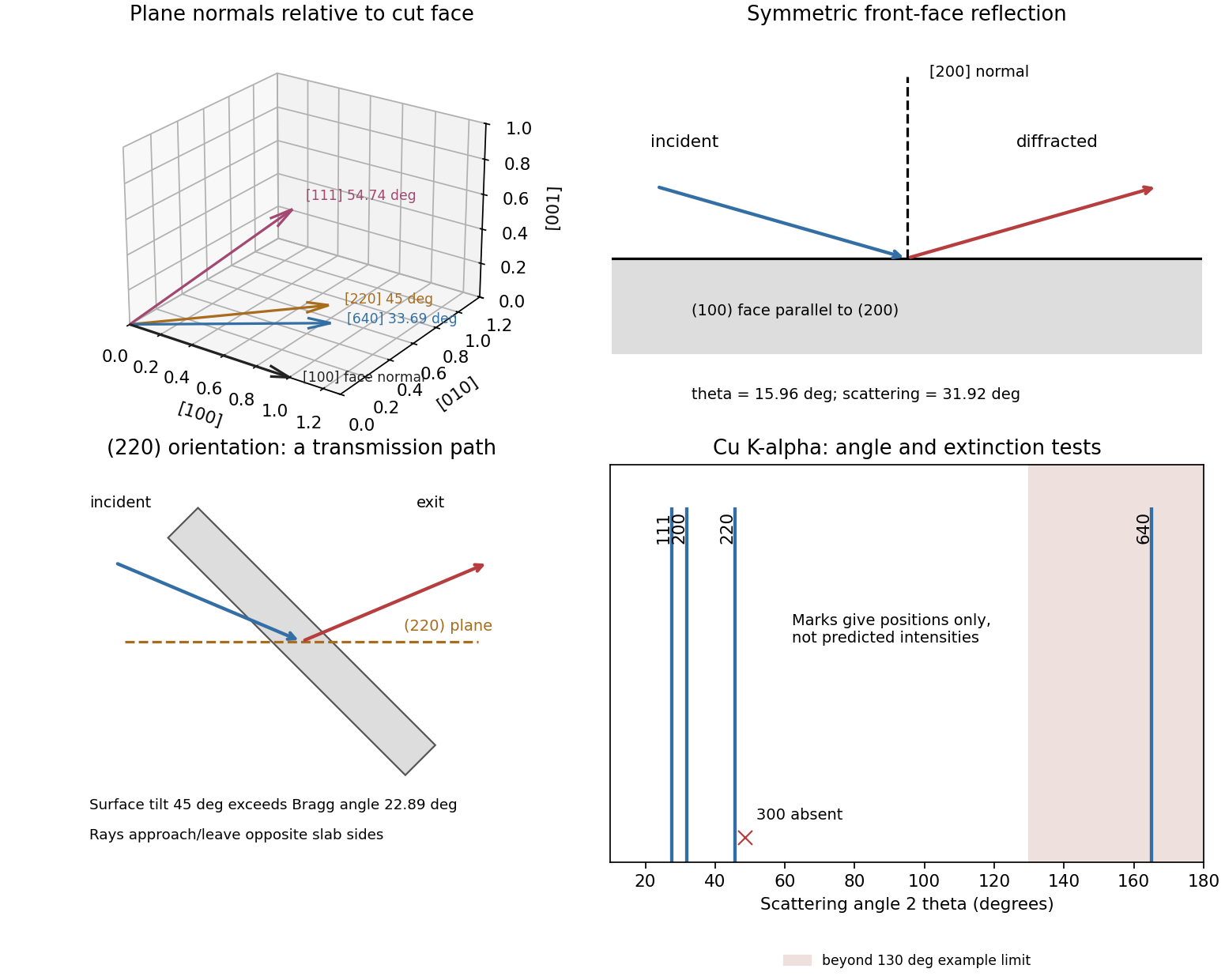
Original diffraction diagrams separating orientation, scattering angle and reflection versus transmission access
. Details. 
The even indices give an allowed reflection. Its spacing is , andThe planes are parallel to the cut face, so the ordinary coupled reflection scan reaches them directly. This is an easy, strong peak, with the two ionic amplitudes adding rather than subtracting.
The reflection is allowed, with and . Its odd-parity amplitude is proportional to , generally weaker than the corresponding sum. Its normal makes with the surface normal.
It is therefore not obtained in the ordinary symmetric scan of that face, despite its modest Bragg angle. In a usual edge-aligned cubic mounting its normal also has an out-of-horizontal-plane component. A suitable multi-axis reorientation, or a crystal cut with a face, makes the reflection accessible; a thin specimen in transmission or a powder experiment is another route. Tilting the scattering vector does not by itself ensure front-face reflection: because exceeds , incident and outgoing rays for that highly asymmetric orientation cannot both lie outside the same flat face. A suitable specimen shape/transmission path or recut face is needed.
The indices have mixed parity, so the face-centred lattice sum vanishes: the ideal NaCl reflection is systematically absent. A smaller wavelength, a larger detector range or an extra rotation axis does not remove that extinction. A nominal peak there could reflect another wavelength/reflection, multiple diffraction, another phase or broken ideal translational symmetry; it would not be an ordinary kinematic reflection of ideal NaCl. The allowed peak is a different reciprocal-lattice vector, not a recovered peak.
The all-even reflection is allowed. Here and . Its normal is from and can lie in the horizontal scattering plane in an edge-aligned mounting. Nevertheless it is not parallel to the large face, so the ordinary coupled symmetric scan misses it.
Independent sample rotation can bring the normal onto the Bragg bisector, but there is an important specimen constraint: is less than the surface inclination. One ray then traverses the slab rather than emerging from the incident face. Thus a thin transmission specimen or access through another face can permit detection after suitable remounting, whereas a thick absorbing slab in front-face reflection is unfavourable. A -cut crystal allows a straightforward symmetric measurement, and a powder specimen supplies the needed orientations. Unlike , no extinction prohibits it; whether the original portable mounting can reach it depends on independent rotation, holder clearance and the transmitting path.
The all-even indices are allowed, but is small. copper givesThis is near backscattering and outside an ordinary portable instrument whose arm reaches only about . The numerical angular limit should be checked on the actual model; the mathematical requirement is that its maximum reach . It also requires a normal inclined to , so the coupled surface-normal scan is insufficient. atomic scattering factors are smaller at this larger scattering vector.
A suitable high-angle, independently orientable diffractometer could detect it. A shorter selected wavelength can instead reduce the angular requirement: with , , while orientation still needs to be set appropriately. If exceeded there would be no first-order Bragg solution at all. The tube continuum and other characteristic lines must therefore be distinguished from the specifically calculated copper peak.
Articles by others on the same topic
There are currently no matching articles.