Solution
ID: past-exam-of-the-mathematical-methods-i-course-of-the-university-of-oxford/2015-resit/12/b/solution
Past exam of the mathematical methods I course of the University of Oxford 2015 resit 12 b Solution by  Codex 0 2026-10-25
After discarding , the preceding inner products show that distinct sine functions are orthogonal; dividing each by makes them orthonormal. More precisely, their infinite expansions form an orthogonal basis of the odd part of in the Hilbert-space sense. This is not a claim that every arbitrary odd function is a finite linear combination of sines.
Take the inner product of with . Orthogonality givesTherefore the Fourier series of a periodic sawtooth, scaled to this interval, isIts periodic extension is piecewise smooth, so the Dirichlet convergence theorem for Fourier series gives pointwise convergence to inside the interval. At the jump endpoints of that periodic extension, the series instead converges to zero, the midpoint of the two one-sided limits.
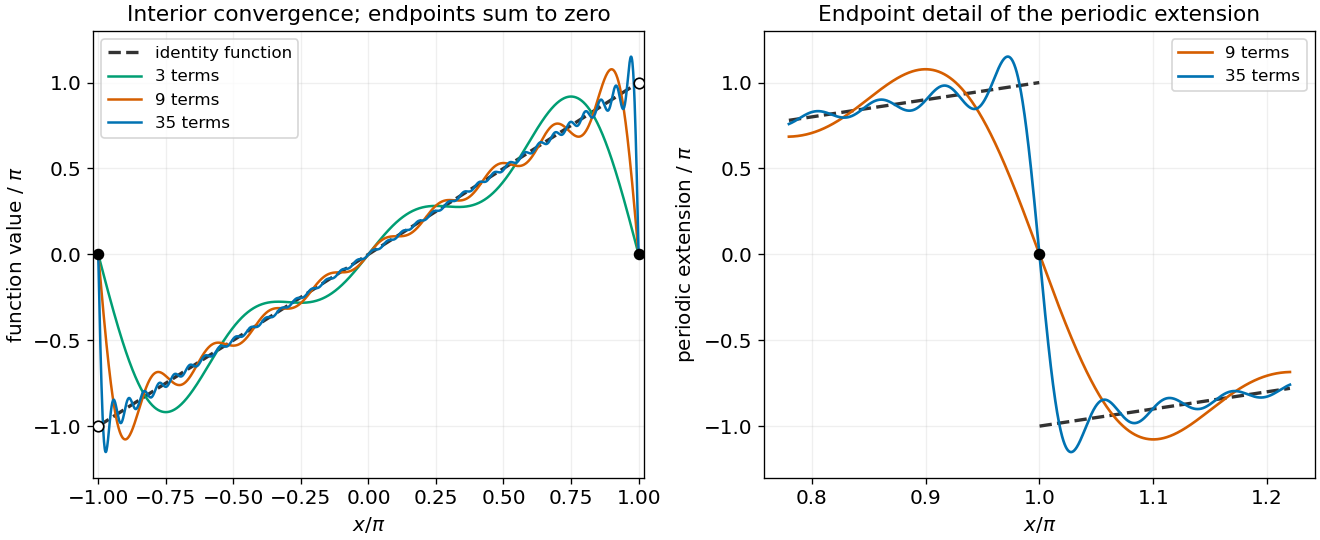
Fourier sine partial sums approximate the identity inside the interval, while their periodic extension has endpoint jumps
. Details. 
New to topics? Read the docs here!