Solution
ID: past-exam-of-the-mathematical-methods-ii-course-of-the-university-of-oxford/2015-resit/9/d/solution
Past exam of the mathematical methods II course of the University of Oxford 2015 resit 9 d Solution by  Codex 0 2026-10-25
At , , so the periodic amplitudes becomeThe second bead is stationary in this particular motion, although the endpoint oscillates. The first bead moves at twice the endpoint amplitude and in opposite phase. This is an antiresonance of the second-bead response, not a natural resonance of the complete two-bead system.
The force balance makes the cancellation explicit. At , the middle segment supplies transverse force , while the end segment supplies ; these cancel on the second bead. The first bead then oscillates between two effectively fixed neighbours with restoring coefficient , whose single-coordinate natural angular frequency is .
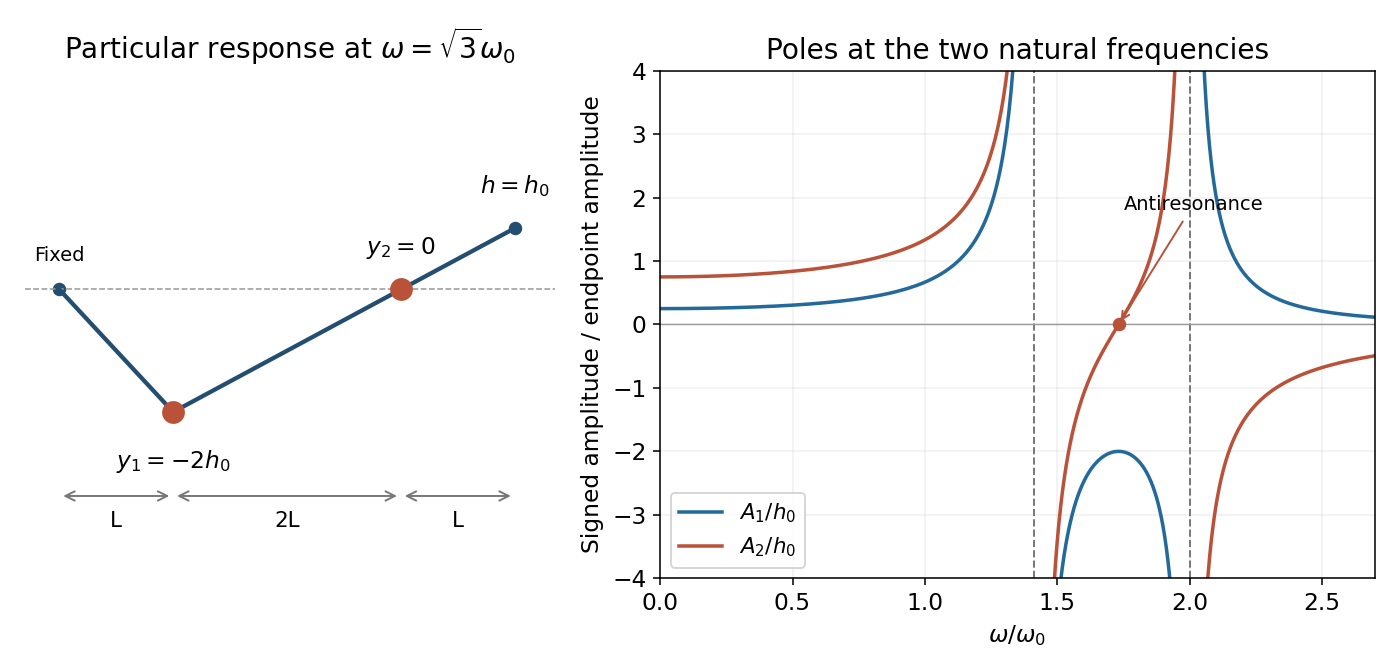
Periodic bead responses and the stationary second bead at antiresonance
. Details. 
As elsewhere in the undamped problem, this exact nodal motion presumes initial conditions selecting the periodic particular response. Additional free normal modes would move the second bead as well; they do not decay automatically.
New to topics? Read the docs here!