Solution
ID: past-exam-of-the-mathematical-methods-ii-course-of-the-university-of-oxford/2017-resit/11/c/solution
Past exam of the mathematical methods II course of the University of Oxford 2017 resit 11 c Solution by  Codex 0 2026-10-25
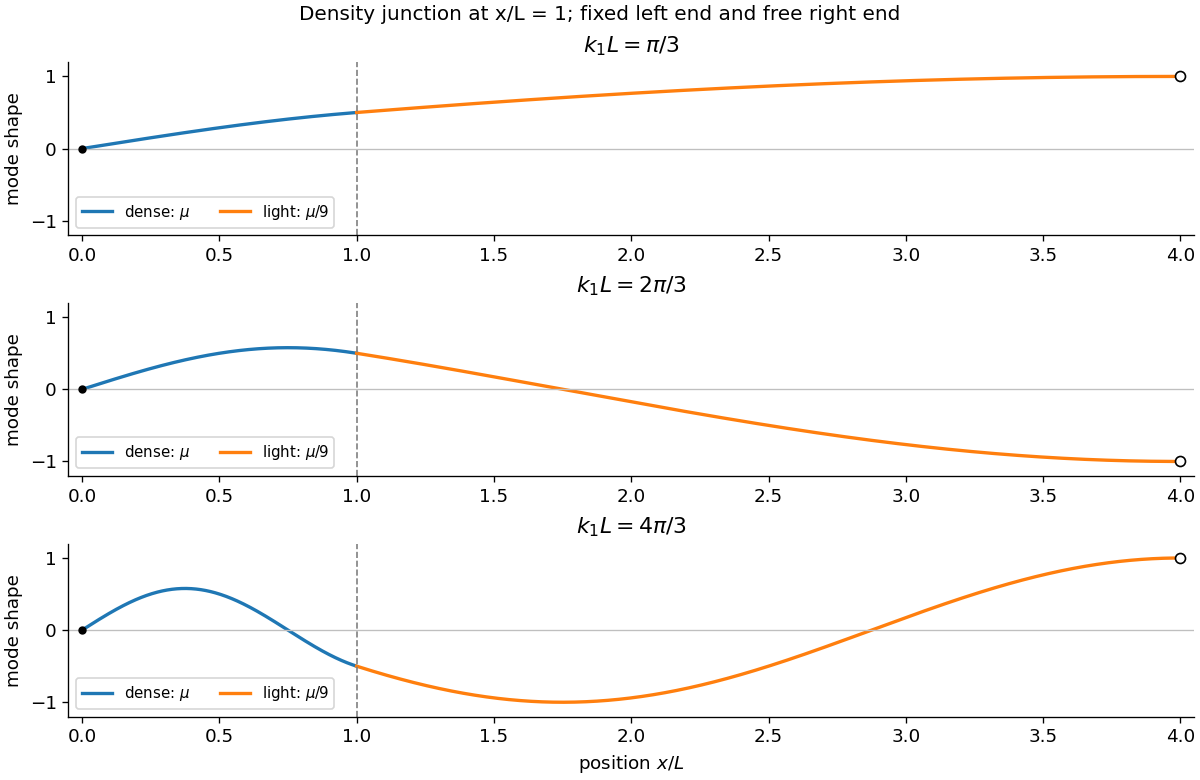
At common tension, the lighter segment has three times the wave speed, so its wavenumber at the same frequency is . The fixed left end and free right end selectLet . Since , continuity of displacement and of transverse force at the junction givesEqual tension makes the second condition continuity of slope. A nontrivial pair of amplitudes requires the coefficient determinant to vanish:For positive frequency, , soNeither nor gives a nonzero mode, as direct substitution into the two matching equations confirms. The positive roots are or for . The first modes in the figure show the changing wavelength across the junction while retaining continuous displacement and slope. The zero-frequency limit must be solved separately; the fixed and free boundary conditions allow only the trivial static solution.

New to topics? Read the docs here!