Solution
ID: past-exam-of-the-mathematics-and-the-environment-and-mathematical-physiology-course-of-the-university-of-oxford/2010/a/2/iv/solution
Past exam of the mathematics and the environment and mathematical physiology course of the University of Oxford 2010 A 2 iv Solution by  Codex 0 2026-10-31
Let the original area be and the increased upstream area be . At , the conservation law flux is strictly convex. Characteristics behind the increase travel faster than those ahead, forming an admissible shock wave. Rankine-Hugoniot conditions give its speedAt the idealized hydrograph jumps from to at . With positive , the diffusion term spreads the rise over a finite interval. The hydrograph is rounded, with an earlier small response and a later approach to the new discharge, rather than an instantaneous jump.
The physical cause is the longitudinal pressure gradient: a local increase in depth influences neighbouring sections and redistributes water before pure downstream transport would deliver a discontinuity. For a small increase, linearization about has speed and diffusivity . The smooth curve in the figure is the exact half-line step response for this linearized advection-diffusion equation; it illustrates the shape without claiming to solve a large nonlinear jump exactly.
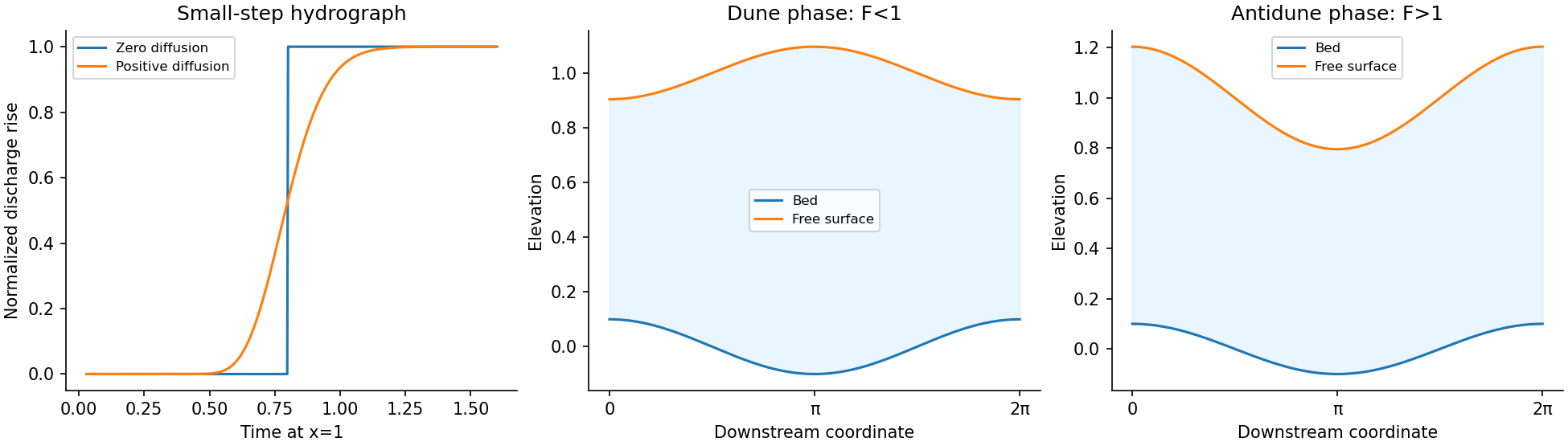
Sharp and diffused downstream hydrographs, with subcritical and supercritical bed-surface phases
. Details. 
New to topics? Read the docs here!