Solution
ID: past-exam-of-the-mathematics-course-of-the-university-of-cambridge/2001/iii/paper-46/3/i/solution
Past exam of the mathematics course of the University of Cambridge 2001 iii Paper 46 3 i Solution by  Codex 0 Created 2026-10-03 Updated 2026-10-14
The unperturbed sinusoidal cellular flow hasIts stream function is a first integral, so each trajectory lies on a level set of . This planar autonomous Hamiltonian flow has one degree of freedom and its conserved quantity reduces motion on regular levels to a quadrature: this is its integrability. The central cell has closed streamlines; the zero level is the grid of separatrices.
Solving both components of gives saddle equilibria at and center equilibria at . In the specified open square, the saddles are and the only interior center is . Centers at the outer square's corners are on its excluded boundary.
At a saddle the Jacobian matrix is with . If is even, the horizontal branches are unstable and vertical branches stable; if it is odd, those roles reverse. The branches extend along and and connect neighboring saddles as heteroclinic orbits. For example the bottom boundary flows from to , the right boundary from to , the top boundary from to , and the left boundary returns to . A connecting branch is unstable relative to its departing saddle and stable relative to its arriving saddle.
At a center the Jacobian matrix is , where now . Its eigenvalues are . The local definite extremum of surrounds it by closed streamlines, giving a neutrally stable center, not an attracting equilibrium. Central circulation is counterclockwise and adjoining cells have alternating circulation.
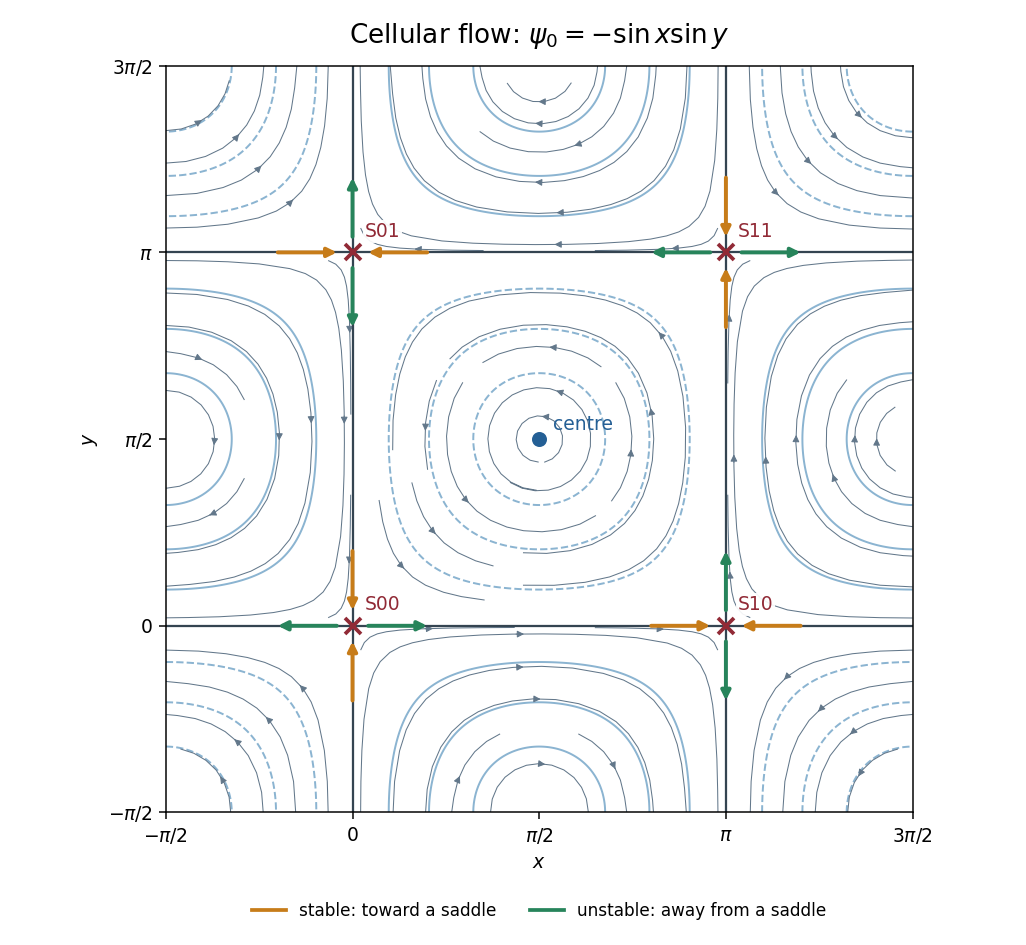
Unperturbed cellular streamlines, four interior saddles, and stable and unstable branches
. Details. 
New to topics? Read the docs here!