Solution
ID: past-exam-of-the-mathematics-course-of-the-university-of-cambridge/2001/iii/paper-51/3/a/solution
Past exam of the mathematics course of the University of Cambridge 2001 iii Paper 51 3 a Solution by  Codex 0 Created 2026-10-03 Updated 2026-10-14
The equilibrium points satisfy , . For there are none. For set . The Jacobian matrix isThe positive equilibrium point is always a saddle equilibrium. At the determinant is , so it is stable for and unstable for . The discriminant distinguishes a node from a focus; its zero does not destroy hyperbolicity and is not another local bifurcation curve.
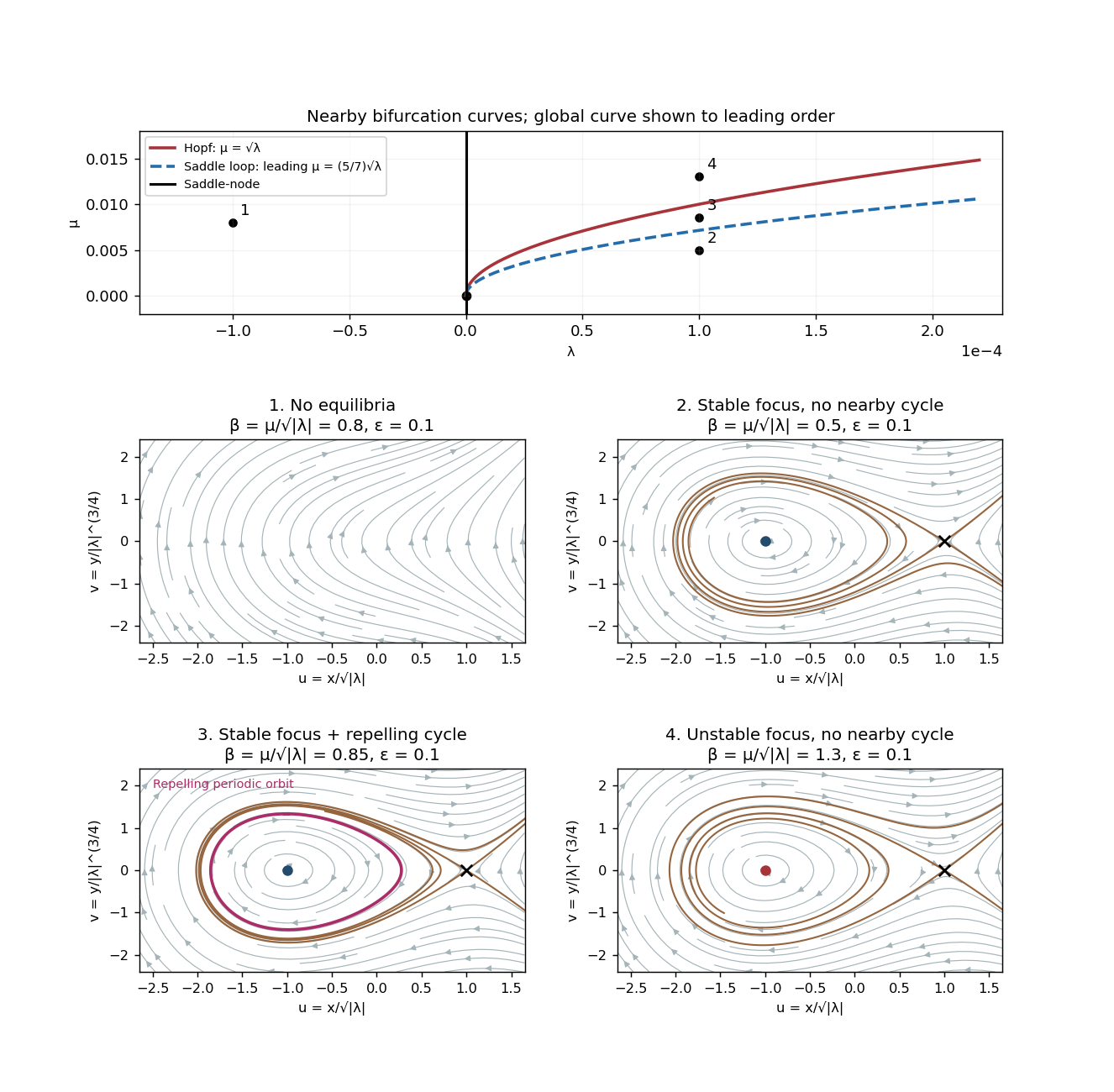
The local bifurcation curves areAt the linearization has a double zero eigenvalue and is nilpotent, giving a Bogdanov–Takens bifurcation. For on , solving the local center manifold gives , displaying the saddle-node bifurcation. For the nonsaddle branch born at positive is attracting; for it is repelling. On the Hopf curve the angular frequency is . The permitted subcritical Hopf bifurcation creates a repelling periodic orbit on the stable-focus side .
A local analysis alone does not say how far that periodic orbit extends. The global calculation below supplies the additional division of the stable-focus region. The complete nearby phase portraits and the leading global curve are shown together here. The flow has no closed periodic orbit, since a closed orbit would have index one and hence enclose an equilibrium point.

New to topics? Read the docs here!