Solution
ID: past-exam-of-the-mathematics-course-of-the-university-of-cambridge/2004/iii/paper-67/4/b/solution
Past exam of the mathematics course of the University of Cambridge 2004 iii Paper 67 4 b Solution by  Codex 0 2026-10-14
Codex 0 2026-10-14A useful description of the low-column Lyman-alpha forest at is a power law , with around – over the ordinary unsaturated forest range. The same column dependence holds for at a fixed redshift. It is not a universal unbroken power law: saturation, increased neutral fraction and changing absorber populations produce breaks. Lyman limit systems become optically thick at because with . Damped Lyman-alpha systems have and strong radiative damping wings. They are rare in number but contain substantial neutral mass. The highest-column distribution steepens or cuts off rather than extending indefinitely.
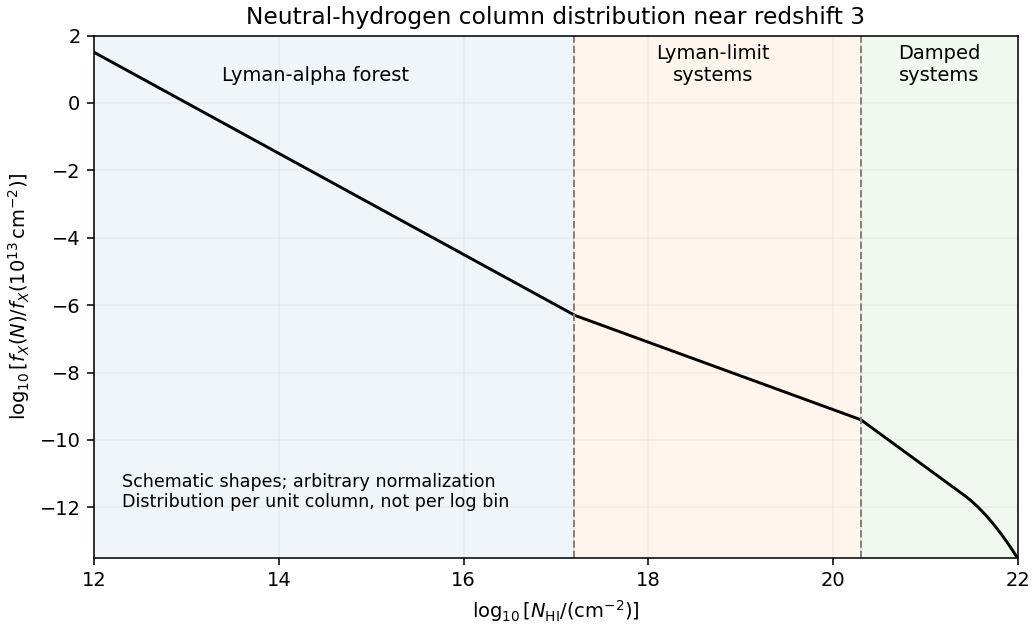
Schematic neutral-hydrogen column distribution showing the forest, optically thick Lyman-limit systems and damped systems
. Details. 
This sketch shows representative shapes and transition scales, not an observational fit; its ordinate is distribution per unit column, not counts per logarithmic bin. In an Einstein-de Sitter universe, , so a fixed comoving population with fixed physical cross-section above a fixed column threshold has . ThusThe observed redshift evolution of the Lyman-alpha forest is much stronger for commonly selected forest lines. For example, Kim, Cristiani and D'Odorico's absorption survey finds an index about in for over , corresponding to an increase by approximately . This number is selection-dependent. Expansion changes the gas density, and the evolving cosmic ionizing background changes its neutral fraction through photoionization equilibrium, moving systems across a fixed neutral-column threshold. Structure also evolves. A non-evolving population with fixed physical cross-section is therefore not an adequate physical model of the observed forest.
New to topics? Read the docs here!