Solution
ID: past-exam-of-the-mathematics-course-of-the-university-of-cambridge/2004/iii/paper-75/5/b/solution
Past exam of the mathematics course of the University of Cambridge 2004 iii Paper 75 5 b Solution by  Codex 0 Created 2026-10-03 Updated 2026-10-14
Assume , , constant , negligible rotation, dissipation and reflection from infinity, small and , and no wave overturning. The terrain is stationary, so laboratory frequency is zero and intrinsic frequency is . Propagation requires . PutThe kinematic boundary condition at the linearized bed is . The upward radiation condition selects the positive branch because . ThusThe internal-wave polarization and every other perturbation follow from this vertical velocity and the linear equations.
In the frame moving with the fluid, , the phase is , andThe intrinsic energy ray slopes upward and upstream, , along a constant-phase line of an internal gravity wave. At fixed intrinsic frequency the spatial wave equation is hyperbolic, with the two characteristic curve line slopes ; the radiation condition selects the upward ray of the appropriate horizontal propagation branch.
In the terrain frame, phase lines remain fixed and the pattern phase velocity is zero. A transported packet hasIts energy path slopes upward and downstream, , and need not coincide with a stationary phase line. One should not add to the chosen normal intrinsic phase velocity and call that the normal ground-frame phase velocity: tangential motion along a phase line is arbitrary; zero laboratory frequency makes the entire crest pattern stationary. The sketch distinguishes stationary crests, intrinsic characteristics and transported energy.
If , is imaginary and the bounded field is an evanescent wave; at the vertical group velocity vanishes and an ordinary upward radiation interpretation degenerates.
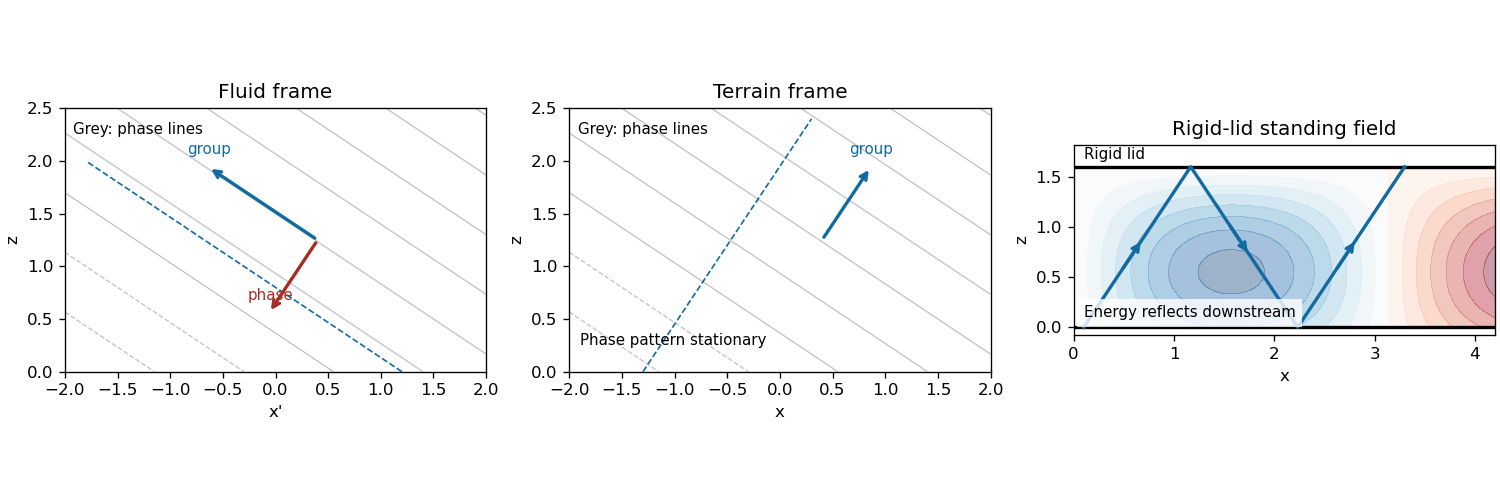
Phase lines and energy rays of topographic internal waves in fluid and terrain frames, with rigid-lid reflection
. Details. 
New to topics? Read the docs here!