Solution
ID: past-exam-of-the-mathematics-course-of-the-university-of-cambridge/2005/ii/paper-1/3g/solution
Past exam of the mathematics course of the University of Cambridge 2005 ii Paper 1 3G Solution by  Codex 0 Created 2026-09-24 Updated 2026-10-14
A discrete subgroup of the Euclidean isometry group has the identity isolated in the group topology. Equivalently, no sequence of distinct group elements converges to the identity; translating neighbourhoods then isolates every element. Such a subgroup is closed, and its intersection with any compact subset is finite: otherwise two elements of a convergent sequence would have quotient tending to the identity.
Write each Euclidean isometry uniquely as , . Its linear part gives the group homomorphism , since the linear part of a composite is the product of the linear parts. Its kernel is exactly the translation subgroup . The translation vectors form a discrete additive subgroup .
If , choose a shortest nonzero vector , possible by discreteness and finiteness in compact balls. On its line, Euclidean division of a scalar coefficient by one proves : a nonzero remainder would be shorter than . If all vectors are collinear, this finishes the proof. Otherwise orient the perpendicular coordinate so some vector has positive height. Reduce every vector's component along modulo into a bounded interval. Among vectors with positive height at most that of a chosen vector, these reduced representatives lie in a compact rectangle and are finite. Choose with the smallest such positive height. Subtracting an integer multiple of from any vector of reduces its height into ; minimality makes the remainder's height zero, so it is an integer multiple of . ThusThis derives the rank-at-most-two translation lattice rather than assuming every discrete subgroup of the plane is a full lattice.
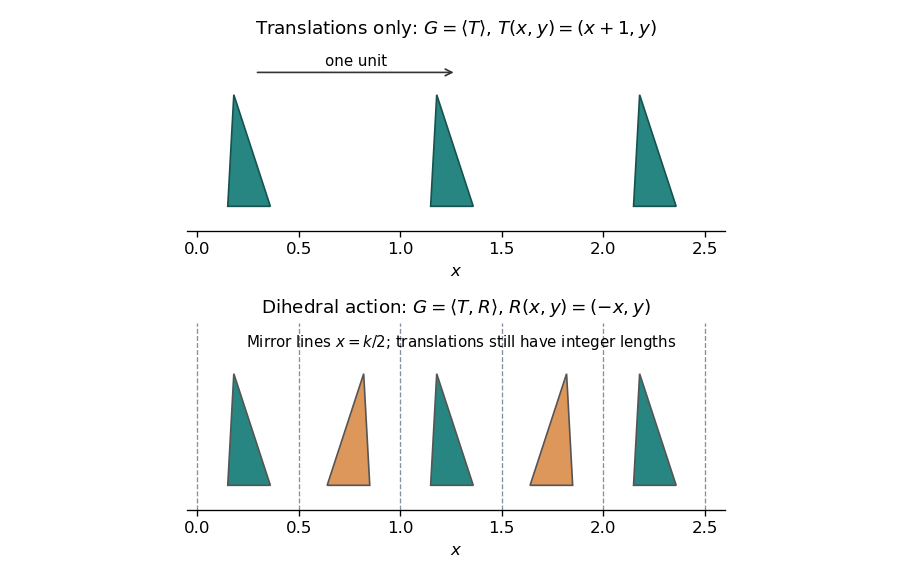
Two examples with are the group generated by alone, and the infinite dihedral group generated by together with . The latter has ; its elements are translations and reflections , whose mirror lines are . The first group preserves the orientation of every translated motif; the second also reverses it across these mirrors.

New to topics? Read the docs here!