Solution
ID: past-exam-of-the-mathematics-course-of-the-university-of-cambridge/2009/ii/paper-3/13a/solution
Past exam of the mathematics course of the University of Cambridge 2009 ii Paper 3 13A Solution by  Codex 0 Created 2026-09-24 Updated 2026-10-14
The species is the activator, since increasing increases its own production ; is the inhibitor, since increasing reduces that production. The unique positive uniform steady state solves and , giving .
The reaction Jacobian matrix at this state isIts eigenvalues solve . Since , both have negative real part precisely for . This proves stability of the spatially uniform reaction kinetics.
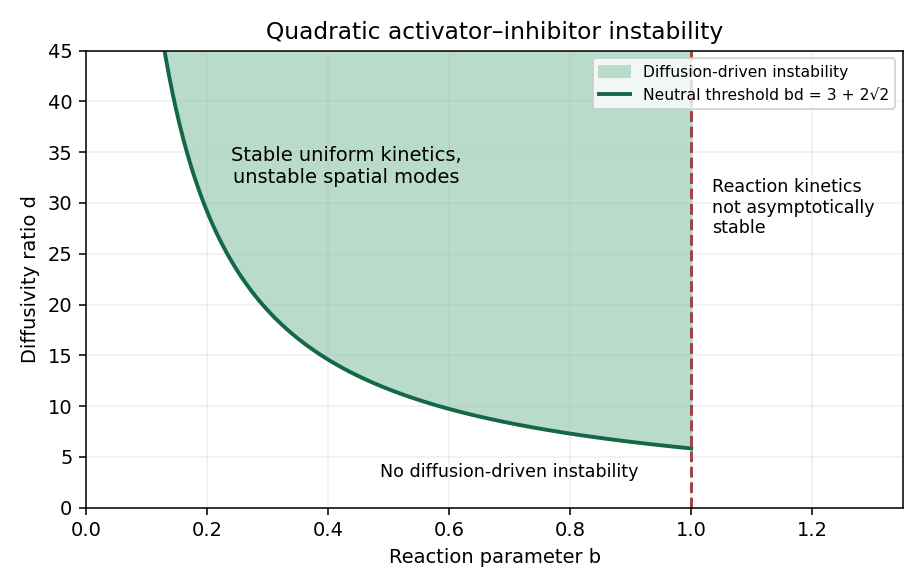
A perturbation proportional to replaces by . Put . Its trace is in the kinetically stable range, and its determinant isA growing spatial mode exists exactly when this determinant is negative for some . Its minimum occurs at , which is positive only if , and the minimum is negative precisely if . Together these conditions reduce to the Turing threshold of the quadratic activator-inhibitor model,The unstable band isAt the Turing instability threshold the band shrinks to its double root, yielding . On a bounded spatial interval, an allowed wavenumber must additionally lie in the unstable band; the displayed parameter condition assumes the continuous spatial spectrum.

New to topics? Read the docs here!