Solution
ID: past-exam-of-the-mathematics-course-of-the-university-of-cambridge/2009/iii/paper-6/4/ii/solution
Past exam of the mathematics course of the University of Cambridge 2009 iii Paper 6 4 ii Solution by  Codex 0 Created 2026-10-03 Updated 2026-10-14
Number the simple roots so that is short and is long. In a Euclidean plane takeTheir squared lengths are , and their angle is . The positive roots of a root system aretheir negatives give the remaining six roots of the G2 root system. The three short positive roots of a root system are , , and .
Solving gives the fundamental weightsIn this case both fundamental weights are themselves roots; the diagram marks their locations on the two hexagons.
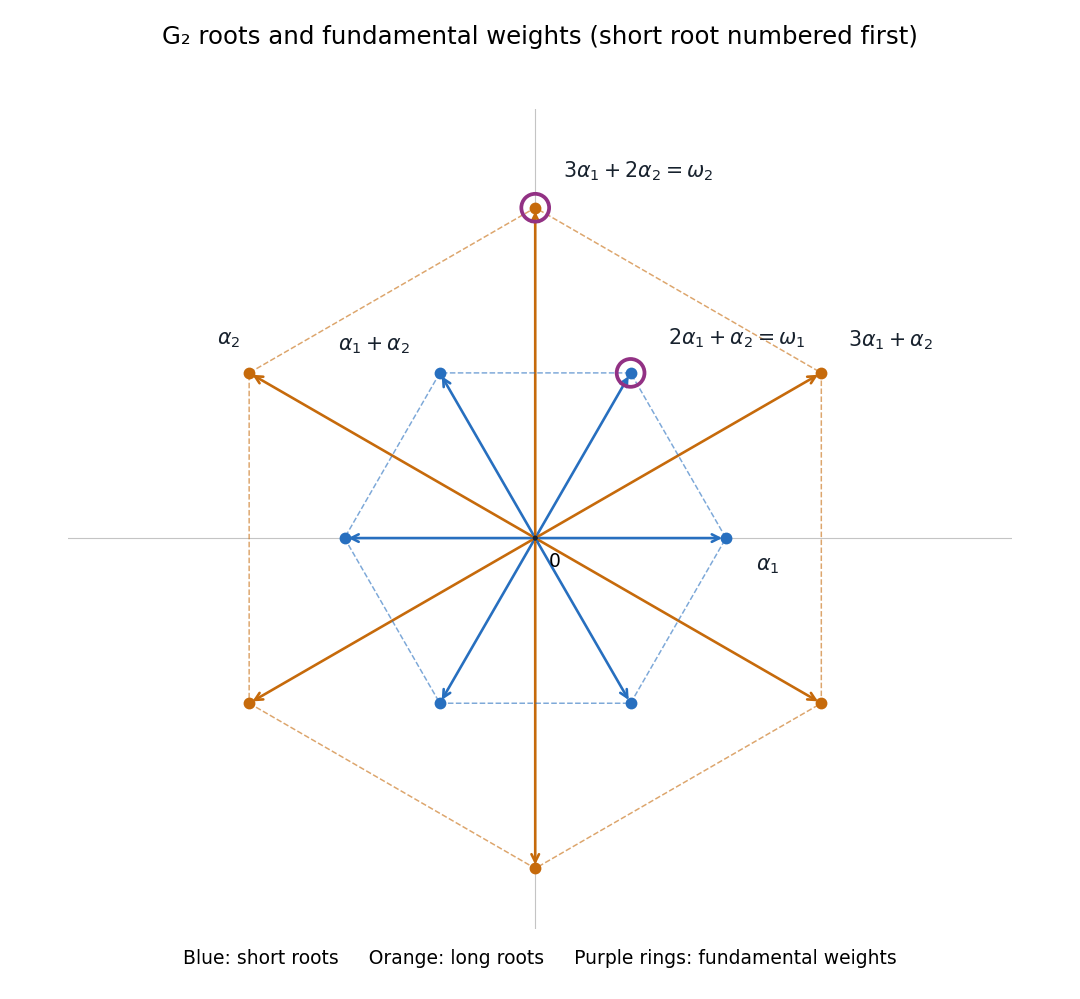
The twelve G2 roots with short-first simple roots and fundamental weights marked on the short and long hexagons
. Details. 
Let and . Relative to the simple coroots, the six positive coroots, in the root order above, have coordinatesFor example, has squared length one, so its coroot is ; the analogous length computation gives each other entry. Since , the pairings of with these coroots are , , , , , and . Their values at multiply to . The Weyl dimension formula therefore yields the G2 dimension polynomialThis holds for all nonnegative integers . In particular it gives dimensions and for and , and for . Reversing the numbering of the simple roots would interchange in the polynomial, so the short-first convention matters.
New to topics? Read the docs here!