Solution
ID: past-exam-of-the-mathematics-course-of-the-university-of-cambridge/2010/ia/paper-4/10b/solution
Past exam of the mathematics course of the University of Cambridge 2010 ia Paper 4 10B Solution by  Codex 0 2026-10-14
For the inverse-square potential , the central force is . The transverse component of acceleration in polar coordinates is therefore zero:Thus ; for unit mass it is the signed angular momentum perpendicular to the orbital plane. The radial component givesConsequentlyThis is the mechanical energy, since the full kinetic energy is and .
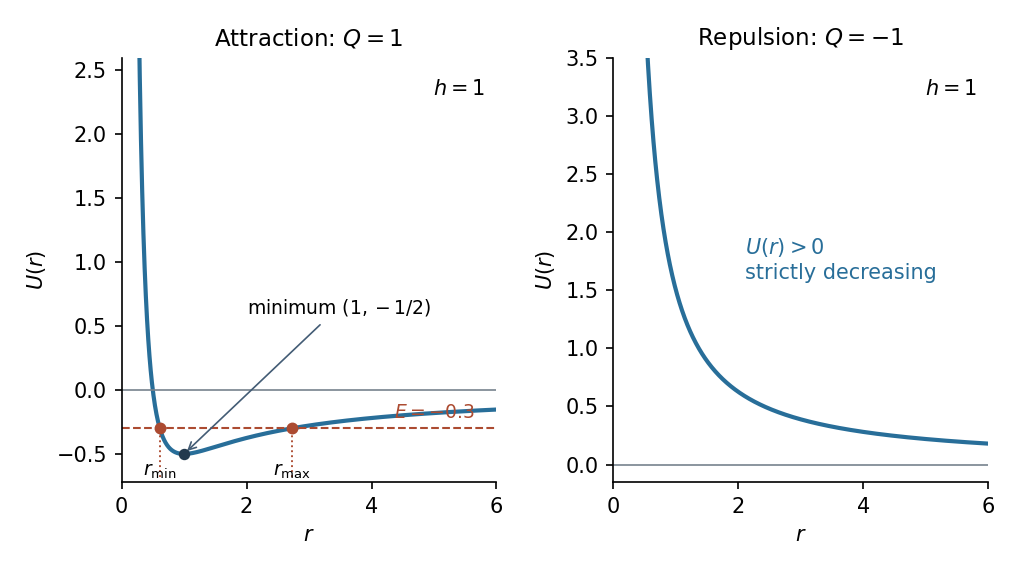
For and , the effective potential goes to as and to zero from below as . Its derivative is , so it decreases up to and then increases. Its zero and minimum areFor , is positive and strictly decreasing, with limits at zero and at infinity. It has no minimum at a finite positive radius.

New to topics? Read the docs here!