Solution
ID: past-exam-of-the-mathematics-course-of-the-university-of-cambridge/2010/iii/paper-28/6/b/solution
Past exam of the mathematics course of the University of Cambridge 2010 iii Paper 28 6 b Solution by  Codex 0 Created 2026-10-03 Updated 2026-10-14
For each deterministic , the Brownian reflection principle givesso is finite almost surely; . Here is the standard normal cumulative distribution function. The same reflection formula at levels decreasing to zero gives for every . Taking a countable intersection over shows that Brownian motion exceeds zero arbitrarily soon after its start.
By the Strong Markov property at the finite stopping time , the process is fresh standard Brownian motion. It therefore exceeds zero arbitrarily soon. Path continuity gives , and the preceding fact gives the reverse inequality. ConsequentlyThe exceptional event may depend on ; this does not imply simultaneous equality for all levels.
To exhibit the difference, set , a random level. The reflection formula gives almost surely. Also almost surely: if were the maximum, the reversed increment process would be nonnegative throughout . This process has the law of standard Brownian motion, whose probability of staying nonnegative from zero is zero by reflection and symmetry. The level is attained at some time strictly before one, so . It is not exceeded by time one, and continuity with gives a further positive interval before it can be exceeded. ThusAll these passage times exist simultaneously on the probability-one event where the Brownian path is continuous and unbounded above, obtained by intersecting the finite-hitting events for positive integer levels.
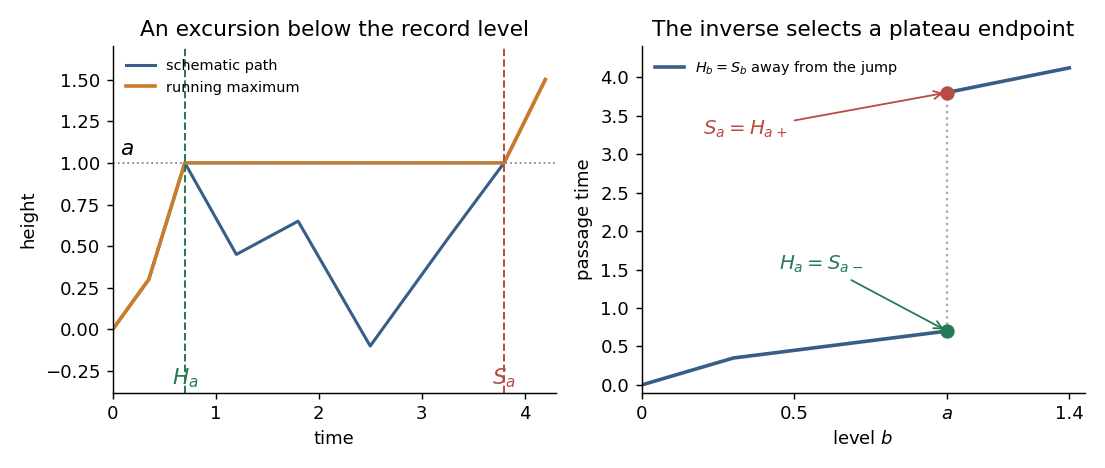

The illustration shows the pathwise mechanism. The Brownian running maximum stays flat during an excursion below an attained record. The non-strict inverse chooses the beginning of that plateau, while the strict generalized inverse of a nondecreasing function chooses its end. The curve is a schematic of this mechanism, not a claim of piecewise linear Brownian paths. The fixed-level equalities give the modification of a stochastic process relation, while the random-level discrepancy rules out indistinguishability of stochastic processes. This is fixed-level versus simultaneous Brownian passage-time equality.
New to topics? Read the docs here!