Solution
ID: past-exam-of-the-mathematics-course-of-the-university-of-cambridge/2010/iii/paper-35/3/b/solution
Past exam of the mathematics course of the University of Cambridge 2010 iii Paper 35 3 b Solution by  Codex 0 Created 2026-10-03 Updated 2026-10-14
Start with zero flow and apply the Ford-Fulkerson algorithm. The following augmenting paths and bottlenecks use the capacities in the original PDF diagram:For example, the second path is limited by the remaining capacity two on and by capacity two on . After the third augmentation, has residual capacity one; the fourth path supplies it through . Every displayed increment is the smallest residual capacity of its path.
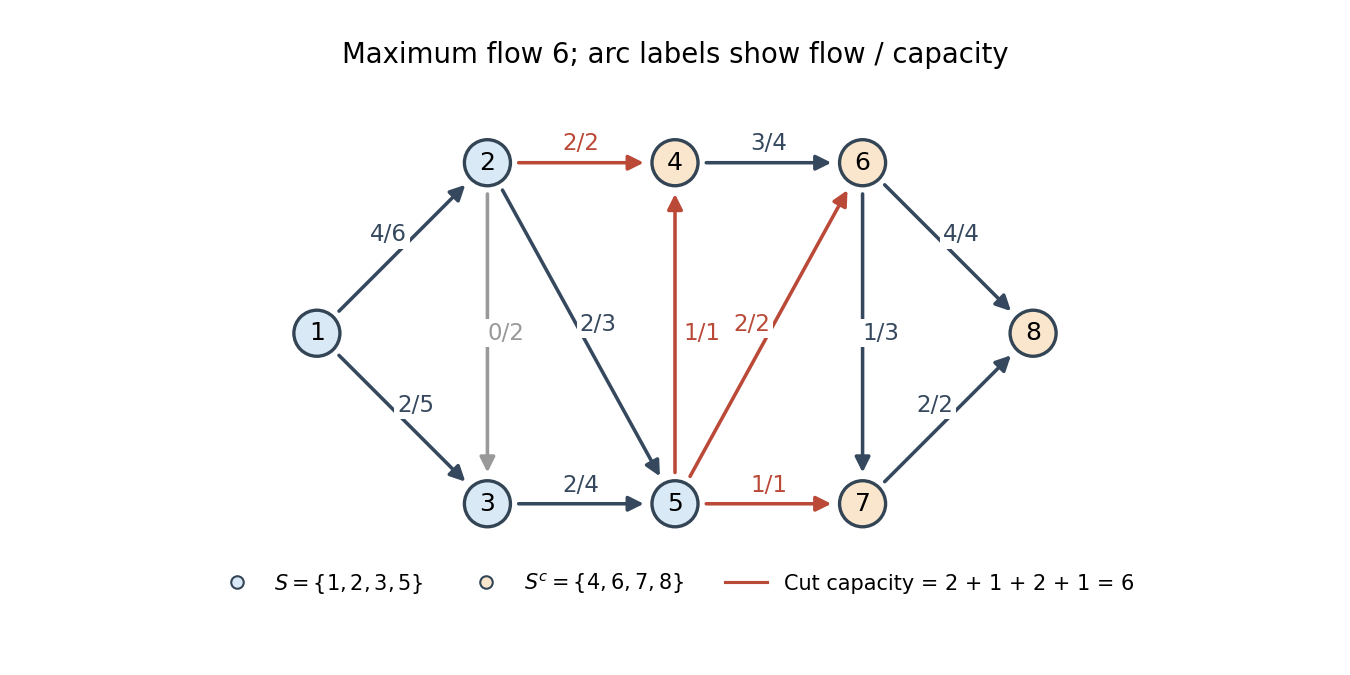
The resulting arc flows areHere denotes . These satisfy every capacity bound and flow conservation. The final residual network has source-reachable set . Its outgoing arcs are , , and , with capacities , all saturated. ConsequentlyThis is a minimum cut, and the equal flow and cut values certify optimality by the max-flow min-cut theorem. The cut immediately before node eight also has capacity six, so the minimum cut is not unique.

New to topics? Read the docs here!