In a finite directed graph with distinct source and sink vertices , a flow records an amount on each original directed edge. For a feasible flow in a flow network, these amounts satisfy the capacity constraints and flow conservation at every vertex other than .[ref]
FlowEdge.java. Algorithms, 4th edition by Robert Sedgewick and others; Sedgewick and Wayne, FlowEdge.java, class documentation and capacity/flow constructor: nonnegative amount on an original directed edge, bounded by capacity
The antisymmetric convention records signed net amounts instead:taking missing edge amounts as zero. The paired signs describe one net transfer, rather than two independent transfers.[ref]
Flows (author-hosted chapter preview). Graph Theory by Reinhard Diestel; Diestel, Flows, §6.2, conditions F1 and F2′, printed p. 158: antisymmetry and conservation at nonterminal vertices
For example, if separate original directed edges and carry and , their net amount is . This signed record loses the separate amounts: , would give the same net amount. When checking capacity constraints on actual edges, keep the original amounts or specify the signed bounds carefully; when summing flow conservation, either record gives the same divergence of a flow.
For the running flow network, choose the original edge amountsEvery capacity constraint holds. At , incoming flow equals outgoing flow ; at , incoming flow equals outgoing flow . This feasible flow has flow value , computed at or .
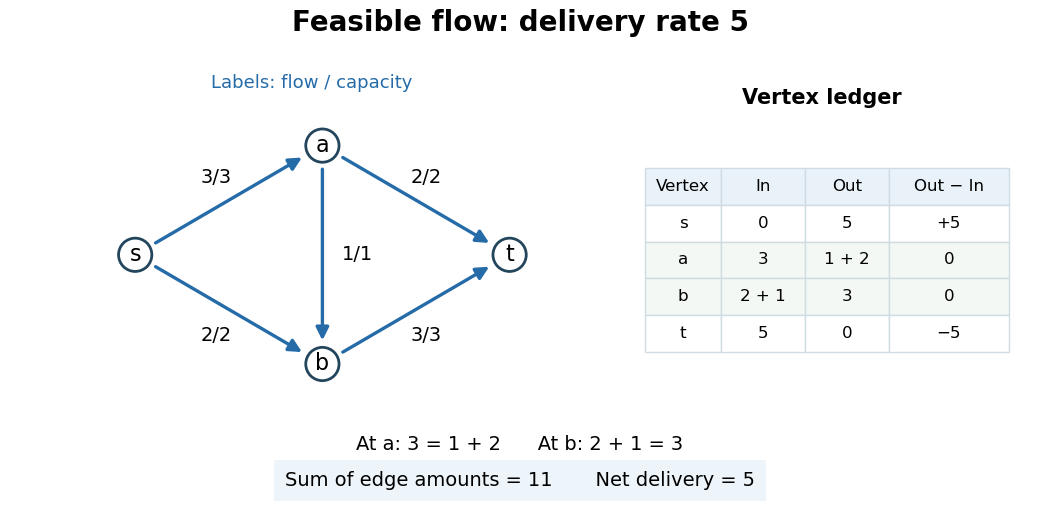

The total of all five edge amounts is , but the flow value is . A unit passing through several edges appears several times in that total. Concretely, route units along each of the directed paths and , and along . Their delivered amounts sum to , while their edge usages sum to . The cut of a flow network certifies that this delivery rate is already a maximum flow.
Flow conservation is useful because it makes a local ledger predict a global delivery rate: intermediate vertices only redistribute the resource. An additional network circulation can change the individual edge amounts without changing the flow value. Counting net delivery rather than total edge usage prevents such recirculation from masquerading as increased output.
A unit flow from to is an antisymmetric flow with net outward strength of a flow one at , net inward strength one at , and zero divergence of a flow elsewhere. For a unit flow to infinity, only the finite source has nonzero divergence.
The divergence of a flow at a vertex is net outward flow. For original nonnegative edge amounts and their signed net record, respectively,Positive divergence of a flow means net supply, negative divergence of a flow means net demand, and zero is flow conservation. This is the same sign convention as flow balance.
In the running example, the divergences of a flow at are . Adding the four divergences of a flow gives zero: every edge contributes positively at one endpoint and negatively at the other. In a finite flow network, this cancellation explains why net supply at equals net demand at .
Flow conservation requires equal total inflow and outflow at every vertex other than the source and sink:Equivalently, the divergence of a flow is zero there.[ref]
FordFulkerson.java. Algorithms, 4th edition by Robert Sedgewick and others; Sedgewick and Wayne, FordFulkerson.java, excess and isFeasible methods, lines 138–175: incoming minus outgoing amount and zero excess at nonterminal vertices
This is a steady accounting condition: an intermediate vertex neither creates the routed resource nor accumulates it. Splitting is allowed; equality between individual incoming and outgoing edges is not required. For the running flow, the equation at is , or , and at it is , or .
Capacity constraints alone do not ensure flow conservation. For instance, changing only from to keeps every edge amount within its flow network edge capacity, but leaves an excess inflow of at and an excess outflow of at . It is therefore not a feasible flow. Changing all affected edge amounts together to restores both equations and gives flow value .
The strength of a flow, also called its flow value, is net outflow from , equivalently net inflow to :The notation denotes this signed value, rather than an absolute value.[ref]
Flows (author-hosted chapter preview). Graph Theory by Reinhard Diestel; Diestel, Flows, §6.2, printed p. 159: total value after Proposition 6.2.1 and footnote 4 on possible negative values
The equality follows by summing the divergence of a flow over all vertices: the internal vertices contribute zero by flow conservation, while every edge cancels between its two endpoints. Hence . For the running flow, .
Net outflow matters even when the source has incoming edges. As a separate example, give , and flow network edge capacities and flow amounts . At , flow conservation reads . The source sends units along outgoing edges but receives back, so the flow value is , exactly the amount arriving at . The two-edge network circulation through raises total edge usage without increasing net delivery.
An infinite locally finite connected graph is a transient graph exactly when it supports a unit flow from a vertex to infinity with finite energy of a flow.
Articles by others on the same topic
There are currently no matching articles.