
The reachable set collects all endpoints attainable from at exactly by admissible control inputs. If arrival any time up to is allowed, use , with . These definitions differ: a general dynamical system may drift away after early arrival, so waiting need not preserve the target. The reachable set is always relative to a declared input class and any constraints on the entire path.
For the double integrator starting from , now require measurable functions as control inputs with almost everywhere. Write for its endpoint at . Two integrals determine the endpoint:Our mathematical example has the exact reachable setTo see the upper boundary, fix : put first and last, switching at . This maximizes the weighted integral for position because early commands have the largest weight ; the required net velocity fixes . Formally, has the same sign as this maximizing command, so changing to any other admissible command with the same integral cannot increase . Reversing the order gives the lower boundary. Pointwise convex combinations of these two commands preserve and attain every intermediate , so the formula describes the whole region, not merely a bound. The extreme commands are bang-bang control.
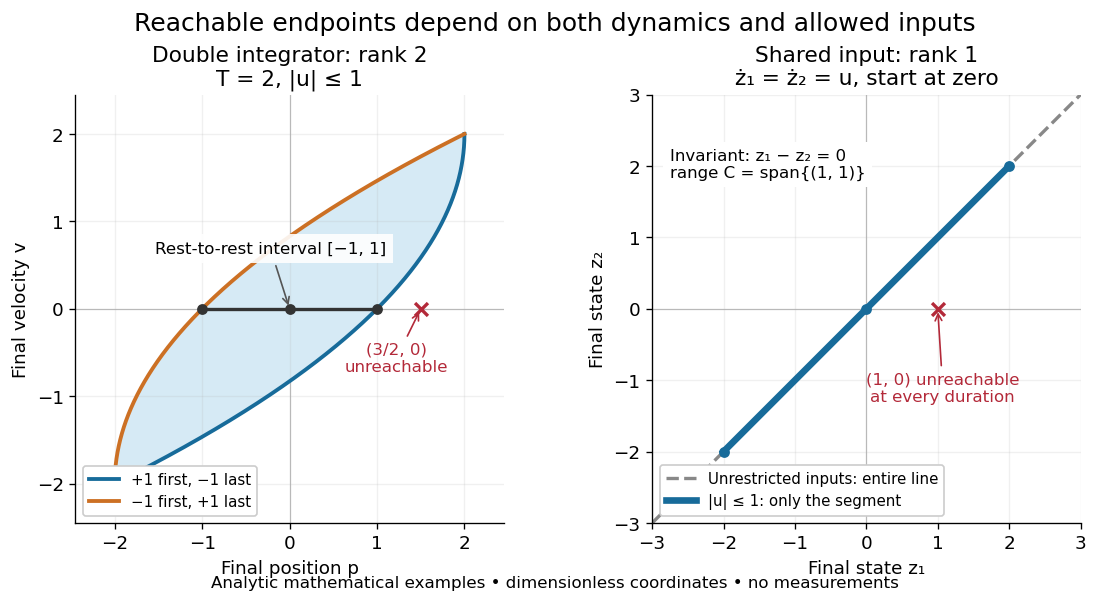

In particular, the bounded double integrator can move from rest to position and rest again exactly when . Its minimum duration is therefore in these normalized units. With freely chosen time every rest-to-rest distance is attainable; with a fixed deadline many are excluded. Changing the amplitude bound to with scales this condition to . This shows why specifying the controls matters even when the Kalman rank criterion gives full rank of a matrix.
In closed quantum control, a density operator reachable set lies inside its unitary orbit of a density operator, since coherent evolution preserves the spectrum. That orbit need not be fully reachable under the available control inputs.
New to topics? Read the docs here!