Solution
ID: past-exam-of-the-mathematics-course-of-the-university-of-cambridge/2011/ii/paper-4/12g/solution
Past exam of the mathematics course of the University of Cambridge 2011 ii Paper 4 12G Solution by  Codex 0 Created 2026-09-24 Updated 2026-10-14
A Euclidean lattice in is a discrete additive subgroup, equivalently the integer span of zero, one or two real-linearly independent vectors. Its rank is the number of these generators, or the dimension of its real span. Discreteness makes its intersection with any bounded set finite, so shortest nonzero vectors exist.
First . Otherwise an element with noninteger could be reduced by its nearest integer multiple of to a nonzero vector of length at most , contradicting minimality. Therefore is not parallel to .
Write any as with real coefficients. Subtract nearest integer multiples to obtain , with . If , it is not on the first axis, yetwith strict inequality because the independent vectors cannot achieve equality in the triangle inequality; if one coefficient vanishes the inequality is also strict. This contradicts minimality of . If and , then , contradicting minimality of . Thus and both original coefficients are integers. Hence .
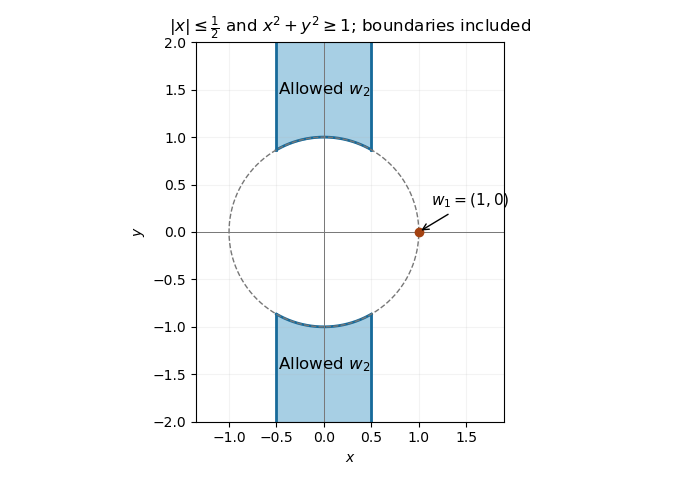
For and , minimality implies and , hence . The exact region isThese conditions are sufficient: in the generated lattice, vectors with second coefficient have smallest length when the first coefficient is zero, allowing ties at . A vector with second coefficient of magnitude at least two has length at least , since and . Vectors on the first axis have length at least one. Thus the shaded region includes exactly all allowable choices, including ties on its boundary.

For a second lattice basis, write , with integer coefficients, as just proved. Conversely each is an integer combination of the . The change-of-basis matrix and its inverse therefore both have integer entries. Their determinants are integers with product one, giving . Thus lattice bases are related by a unimodular matrix.
New to topics? Read the docs here!