Solution
ID: past-exam-of-the-mathematics-course-of-the-university-of-cambridge/2013/iii/paper-41/2/solution
Past exam of the mathematics course of the University of Cambridge 2013 iii Paper 41 2 Solution by  Codex 0 Created 2026-10-03 Updated 2026-10-14
Codex 0 Created 2026-10-03 Updated 2026-10-14Variation with respect to the Dirac adjoint, the Dirac field, and the real scalar field respectively givesThe derivative in the adjoint equation acts to the left; its sign follows by integrating by parts. The Yukawa interaction supplies a spacetime-dependent effective fermion mass and a scalar source.
Use and the convention . The momentum-space Feynman rules are: a scalar internal line contributes ; an oriented fermion line contributes ; and each scalar-fermion vertex contributes times the identity in spinor space. Impose four-momentum conservation at each vertex. Incoming and outgoing fermions supply and , while incoming and outgoing antifermions supply and ; scalar external legs supply one. Loop momenta are integrated with , a closed fermion loop contributes a minus sign, and graph symmetry factors are included. Relative signs between distinct contractions of identical external fermions follow from their anticommutation relations. These specify the Feynman rules also beyond the tree approximation.
Label incoming momenta and outgoing momenta , with all external particles on shell. Write the Mandelstam variables as , , , and abbreviate . Spin indices on are implicit. The six required tree-level Feynman diagrams are:
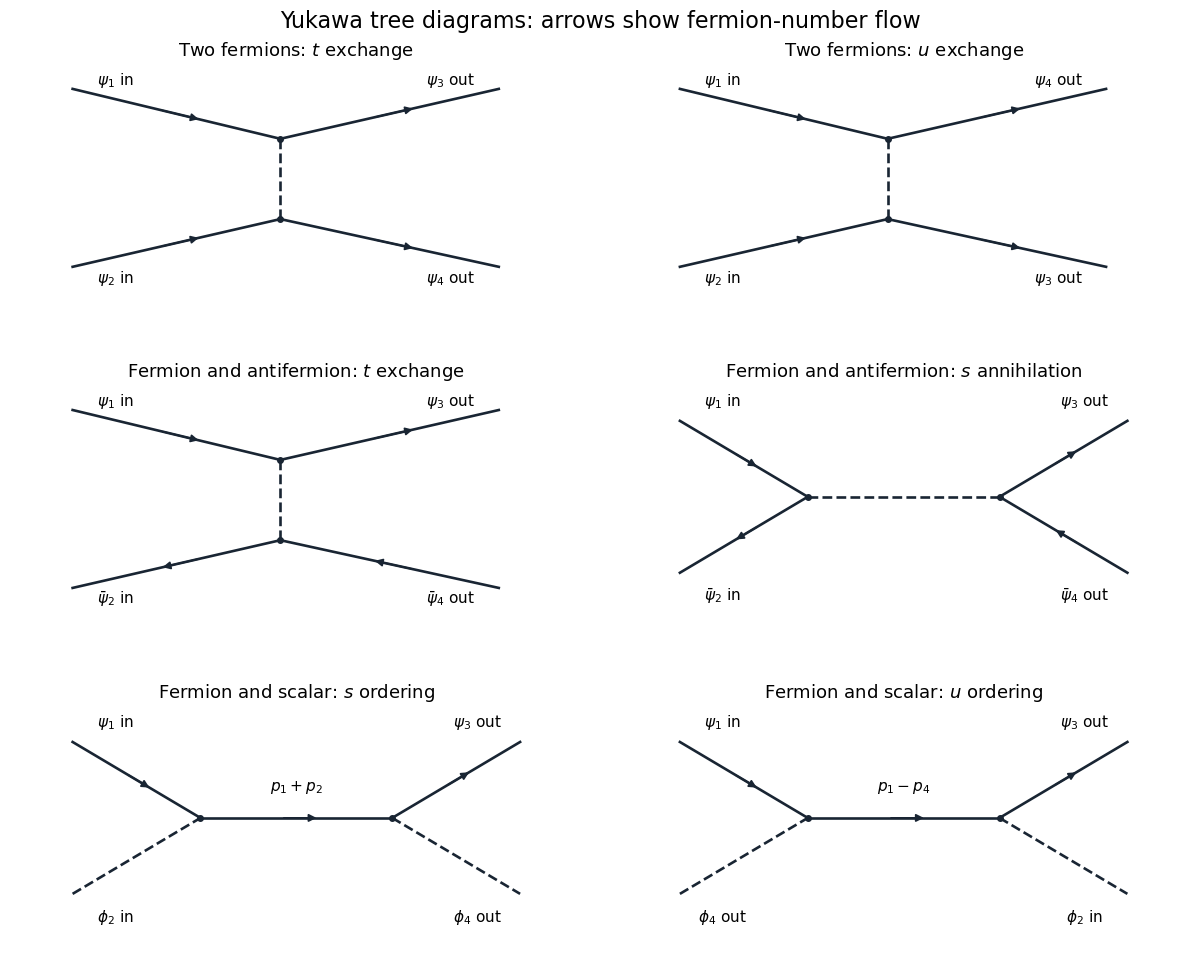
The six Yukawa tree diagrams for fermion, antifermion and scalar scattering, with momentum labels and fermion-number arrows
. Details. 
For two incoming fermions, the two diagrams exchange a scalar in the and channels. With external state ordering and , the result isEach scalar-exchange contraction has two factors and one scalar Feynman propagator. Exchanging the final fermions reverses the sign, as required by their identical-particle statistics.
For a fermion and antifermion, there is -channel scalar exchange and -channel annihilation. Take both initial and final states ordered as fermion creator followed by antifermion creator. ThenThe relative minus is not optional. One way to track it is the antifermion sign of a normal-ordered bilinear: the antifermion scattering part of is , whereas its annihilation part is . Thus the exchange contraction has the opposite fermionic sign to the annihilation contraction before multiplying by . A different overall phase convention for external states changes the common sign of this amplitude, but cannot change the relative sign.
For fermion-scalar scattering, the fermion can absorb the incoming scalar before emitting the outgoing one, or emit first and absorb afterwards. The internal momenta are and respectively, givingBoth orderings have the same sign: there is only one open fermion line and no exchange of identical external fermions. There is no scalar-exchange diagram because this Yukawa interaction has no three-scalar vertex. These amplitudes describe tree scattering in Yukawa theory.
New to topics? Read the docs here!