Solution
ID: past-exam-of-the-mathematics-course-of-the-university-of-cambridge/2013/iii/paper-41/3/solution
Past exam of the mathematics course of the University of Cambridge 2013 iii Paper 41 3 Solution by  Codex 0 Created 2026-10-03 Updated 2026-10-14
Codex 0 Created 2026-10-03 Updated 2026-10-14The conjugate complex scalar field has the opposite charge. Thus the derivative on in the kinetic term must mean , while the derivative on is . This is the conjugate gauge covariant derivative. Applying the same plus-charge differential operator to both fields would not give the stated gauge-invariant theory. For example, take , and ; the literal plus-charge kinetic product changes from to . The opposite-charge interpretation removes this term.
For an arbitrary real function , takeThen and the conjugate derivative transforms oppositely. Also because mixed derivatives commute. The kinetic contraction and are unchanged, proving local U(1) gauge symmetry.
Expanding the covariant kinetic term identifies the interactions:The first term gives the scalar electrodynamics three-point vertex, and the second gives the seagull vertex. For scalar charge flow from an incoming particle of momentum to an outgoing one of momentum , the factors areThe factor two in the second rule comes from the two identical photon fields. Equivalently, with all momenta incoming, the three-point rule is for a leg of momentum and a leg of momentum . An antiparticle line has the opposite charge-flow sign. The vertices are shown with dashed scalar lines and wavy photon lines:
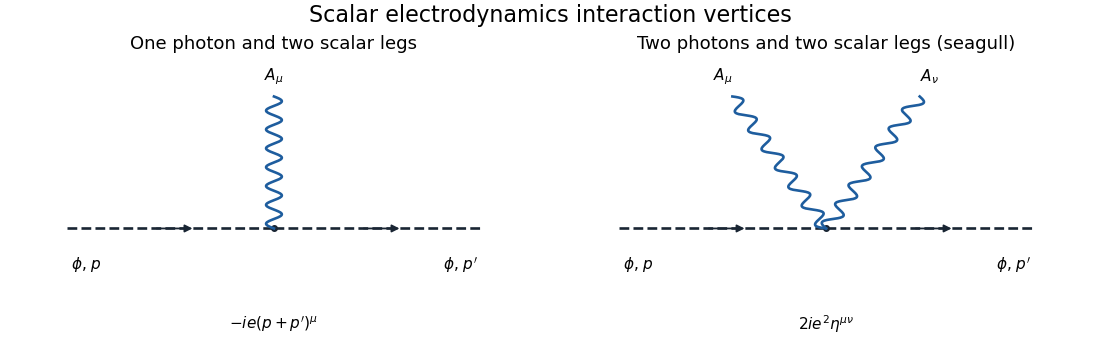
The one-photon scalar vertex and the two-photon seagull vertex in scalar electrodynamics, including their momentum-space factors
. Details. 
For particle-antiparticle scattering, use incoming and outgoing , with particle momenta. At order , there are exactly two tree-level Feynman diagrams: -channel photon exchange and -channel annihilation. The seagull vertex has only two scalar legs and cannot alone provide four external scalar legs.
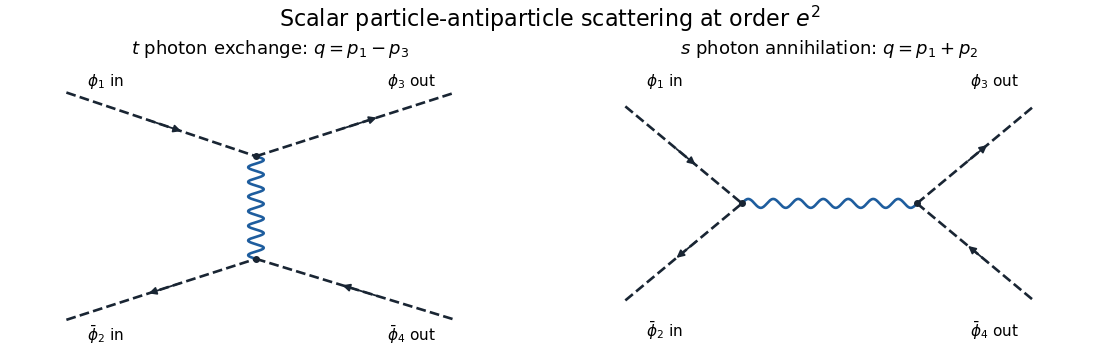
The leading t-channel photon exchange and s-channel annihilation diagrams for scalar particle-antiparticle scattering
. Details. 
Set and . The external currents areAll are transverse to the corresponding exchanged momentum: for instance and . This is the on-shell scalar quantum electrodynamics Ward identity. With the vertex convention above,The relative sign comes from the opposite particle/antiparticle charge in the exchange diagram and the two equal annihilation-vertex signs.
To see how the Coulomb gauge expression becomes covariant, let be either pair, , and initially take . The displayed photon propagator givesCurrent conservation gives and the same identity for . Since , the temporal coefficient simplifies asThereforeThe common Feynman pole prescription is understood in these formulas. This Coulomb-gauge propagator between conserved currents identity proves equality of the physical amplitudes despite the noncovariant individual propagator components. It should be formed before taking limits such as : individual instantaneous and transverse terms can be undefined separately in that limit while their sum has a finite covariant limit away from a physical pole.
Substitution gives the final scattering amplitudeHere are the Mandelstam variables for the equal-mass external scalars. This is scalar particle-antiparticle tree scattering; overall external-state phases do not affect its relative channel sign.
New to topics? Read the docs here!