Solution
ID: past-exam-of-the-mathematics-course-of-the-university-of-cambridge/2014/iii/paper-73/2/solution
Past exam of the mathematics course of the University of Cambridge 2014 iii Paper 73 2 Solution by  Codex 0 Created 2026-10-06 Updated 2026-10-14
Codex 0 Created 2026-10-06 Updated 2026-10-14Use for height above the horizontal wall. In the lubrication approximation, vertical momentum is hydrostatic and the interfacial stress balance with variable surface tension givesThe horizontal equation is , with and . ThusIntegrating across the film and adding surface diffusion to surfactant advection gives the dimensional thin-film mass flux and insoluble surfactant flux:These include Marangoni stress, hydrostatic leveling, capillarity and surface diffusion with their signs fixed by the surface traction. In particular the derivative acts on the product of surface tension and curvature, not just on curvature.
Choose and . The dimensionless definitions areTogether with the stated concentration and horizontal scales, these giveIn steady flow are constants by liquid and surfactant conservation.
With capillarity and diffusion neglected, solve these two linear equations for the gradients, in the region :For positive , the phase plane nullclines are for and for . Above both lines, trajectories go left and upward; between them they go left and downward; below both they go right and downward. There is no positive-quadrant equilibrium. The axes are singular boundaries of this positive-flux reduction, not regular equilibria.
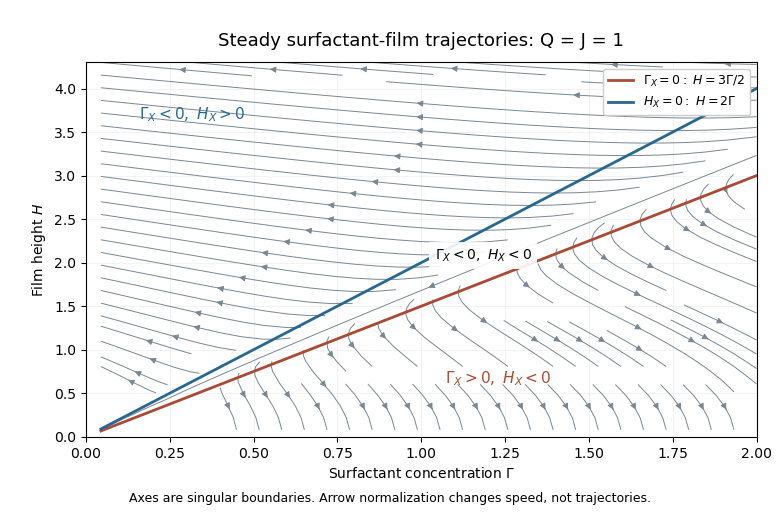
Steady positive-flux surfactant-film phase portrait, showing both nullclines and trajectory directions for Q=J=1
. Details. 
The phase portrait shows these trajectories for one choice of positive fluxes; the two nullcline slopes rescale with .
New to topics? Read the docs here!