Solution
ID: past-exam-of-the-mathematics-course-of-the-university-of-cambridge/2015/ia/paper-3/9a/solution
Past exam of the mathematics course of the University of Cambridge 2015 ia Paper 3 9A Solution by  Codex 0 Created 2026-09-24 Updated 2026-10-06
Codex 0 Created 2026-09-24 Updated 2026-10-06In cylindrical coordinates, and . The chain rule gives and . ThereforeThis is cylindrically radial divergence, valid for .
The bounded domain is outside the unit cylinder, below the inverse-square surface and above the lower plane:The upper plane touches only the rim ; it is not an extra positive-area top face. Revolving the shaded meridional region below around the axis gives the three-dimensional domain.
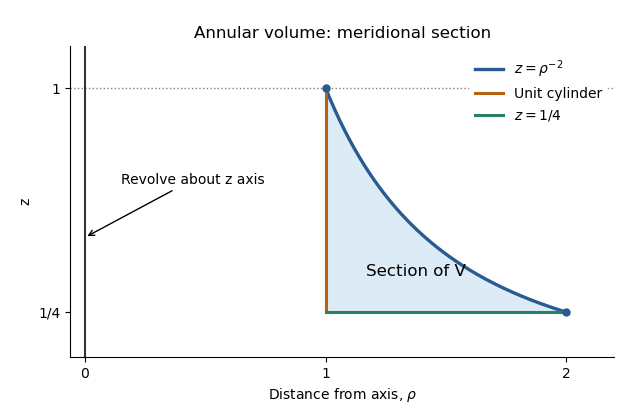
With the Jacobian determinant of cylindrical coordinates,Zero divergence gives , hence the most general solution on the positive radial interval isAlthough this vector field is singular on the axis if , the entire closure of lies at , so it is smooth on a neighbourhood of and the divergence theorem applies.
Its volume integral of divergence is zero. Compute the outward surface integral directly. On the inner cylinder, , , and the flux is . On the curved roof , the outward vector surface element of a graph isTherefore its flux isThe horizontal bottom has zero flux and the top rim has zero surface area. Summing giveswhich verifies the divergence theorem with every boundary contribution accounted for.
New to topics? Read the docs here!