A smooth family assigns a tangent vector at each space-time point. Its flow maps solve , with the identity. For a varying differential form, differentiation gives .
A smooth time-dependent vector field on a compact manifold without boundary has flow maps throughout each compact time interval on which the field is defined. Finite-time escape is impossible on the compact state space. Uniqueness and the backward-time equation supply smooth inverses, so the flow is a smooth isotopy.
Differentiate the displayed homogeneity relation in at . On every regular point of , the radial vector field is therefore perpendicular to the normal gradient and tangent to the level surface. Its flow preserves that zero set. At a singular vertex this flow formulation remains meaningful even if there is no tangent plane.
For , the gradient satisfies . The product rule and Einstein notation then give the displayed divergence formula in dimension . In dimension three, its derivative matrix is symmetric, so the curl vanishes. Zero divergence forces on each positive radial interval. This formula does not assert regularity at the origin.
The vector field has zero curl away from its excluded axis, but has circulation around a positively oriented circle enclosing that axis. Stokes theorem gives zero total circulation for a smooth annular surface avoiding the axis, whose inner and outer boundary circles have opposite orientations. It cannot be applied directly to a disk meeting the axis, because the field is undefined there.
An integral curve follows a vector field by solving the displayed ordinary differential equation. For a smooth vector field, integral curves through initial points assemble into its local flow.
For a continuously differentiable nonzero vector field , the curvature of a space curve following its direction isTake the unit tangent vector and differentiate with respect to arc length. The derivative of is parallel to and disappears from . Since , we have , proving the formula. It remains valid with zero curvature, even where the usual Frenet frame is undefined.
An axisymmetric vector field is invariant under rotations about a chosen axis. In cylindrical coordinates, its components are independent of the azimuthal angle.
Articles by others on the same topic

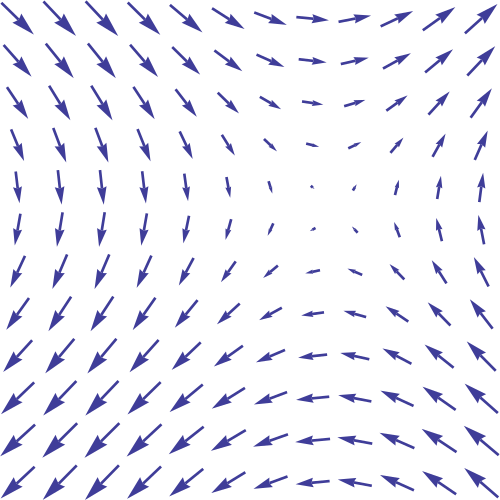
A vector field is a mathematical construct that assigns a vector to every point in a space. It can be thought of as a way to represent spatial variations in a quantity that has both magnitude and direction. Vector fields are widely used in physics and engineering to model phenomena such as fluid flow, electromagnetic fields, and gravitational fields, among others.