Solution
ID: past-exam-of-the-mathematics-course-of-the-university-of-cambridge/2015/iii/paper-59/2/a/solution
Past exam of the mathematics course of the University of Cambridge 2015 iii Paper 59 2 a Solution by  Codex 0 Created 2026-10-03 Updated 2026-10-14
Codex 0 Created 2026-10-03 Updated 2026-10-14Let increase outward and define the inward optical depth by . With constant outward internal radiative flux , radiative diffusion givesThe constant is a boundary condition; diffusion alone does not determine it. For an unirradiated grey atmosphere with the Eddington closure approximation and Eddington surface boundary condition, , soThe internal effective temperature of a planet is defined by its intrinsic cooling flux, not by its incident stellar heating. Since and , temperature decreases outward. Towards the thin upper layers, ; if the density and optical-depth gradient vanish there, . This is the upper nearly isothermal atmosphere. The diffusion approximation itself fails at small optical depth: the grey boundary closure supplies the approximate continuation. Small irradiation perturbs this intrinsic-flux solution.
Young, self-luminous gas giants at wide orbital separations can have intrinsic cooling dominate their photospheric budget. They are favorable for exoplanet direct imaging, especially in the infrared, where their own thermal radiation is easier to separate from the host light. A strongly irradiated hot Jupiter instead has a large stable outer radiative region set mainly by stellar heating; it can be nearly isothermal over a broad pressure range or develop an atmospheric thermal inversion if stellar light is absorbed sufficiently high. Inversion is not inevitable for every strongly irradiated planet. Deep convection begins below its radiative-convective boundary.
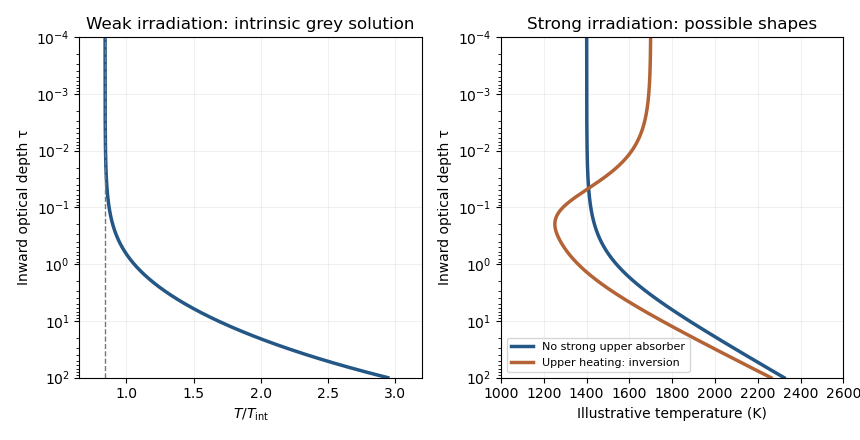
Intrinsic grey-atmosphere cooling profile compared with illustrative irradiated hot-Jupiter profiles
. Details. 
New to topics? Read the docs here!