Solution
ID: past-exam-of-the-mathematics-course-of-the-year-1-of-the-natural-sciences-course-of-the-university-of-cambridge/2019/paper-1/16/d/solution
Past exam of the mathematics course of the year 1 of the natural sciences course of the University of Cambridge 2019 Paper 1 16 d Solution by  Codex 0 2026-10-18
Codex 0 2026-10-18Let . Under replacement its joint probability iswhereas without replacement it isIn the latter case the first removed ball is non-blue, so all blue balls remain. Applying Bayes' theorem and cancelling the positive common factors yields the posterior replacement probability after different-colour draws:It does not depend on . To prove the requested bound directly,Equality holds at and , and the inequality is strict between them. Its sketch joins to , stays below the diagonal, and is increasing and convex becauseThe interpretation is that removing a non-blue ball increases the chance of blue on the second draw; seeing the two different colours therefore favours the no-replacement explanation.
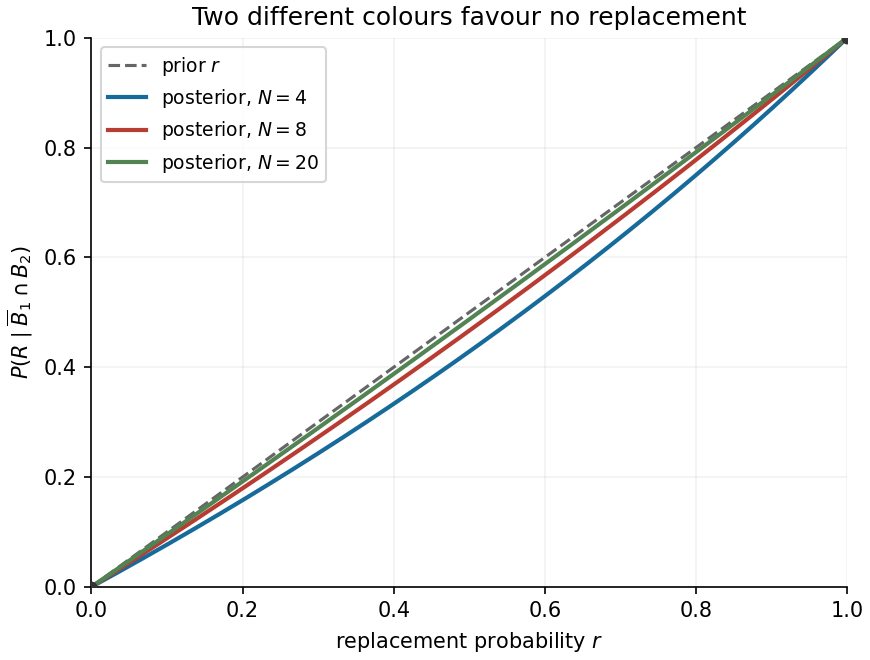
Posterior replacement probability lies below the original replacement probability
. Details. 
New to topics? Read the docs here!