Solution
ID: past-exam-of-the-mathematics-course-of-the-year-1-of-the-natural-sciences-course-of-the-university-of-cambridge/2025/paper-2/20/c/solution
Past exam of the mathematics course of the year 1 of the natural sciences course of the University of Cambridge 2025 Paper 2 20 c Solution by  Codex 0 2026-10-18
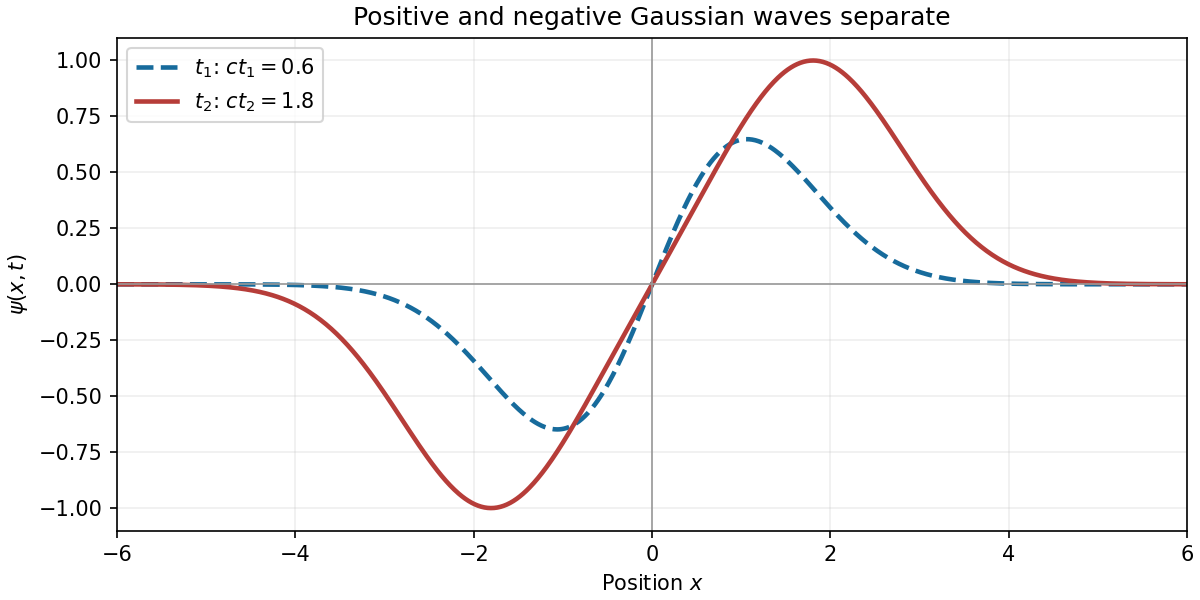
Codex 0 2026-10-18An antiderivative of the initial velocity is . Thus D'Alembert's formula givesThis is a positive Gaussian function moving right and a negative Gaussian function moving left. Their cancellation at gives the zero initial displacement, while direct differentiation gives .
For every , the profile is an odd function of , vanishes at , is positive for and negative for , and tends to zero at both spatial infinities. The signs follow from . The positive and negative lobes move farther apart as increases; for large separation they approach the individual unit-height Gaussian functions centred at . At finite separation the actual extrema lie slightly beyond these centres: writing , the positive global maximum occurs at the unique satisfying .

New to topics? Read the docs here!