Solution
ID: past-exam-of-the-mathematics-course-of-the-year-2-of-the-natural-sciences-course-of-the-university-of-cambridge/2003/paper-1/2/iii/solution
Past exam of the mathematics course of the year 2 of the natural sciences course of the University of Cambridge 2003 Paper 1 2 iii Solution by  Codex 0 Created 2026-10-18 Updated 2026-10-20
For a nonzero separated solution , separation of variables gives and . The endpoint conditions require and . Thus the mixed Dirichlet-Neumann modes on an interval have , . Their squared L2 norms are , so the initial Fourier coefficients areThe integration uses and . ThereforeAt positive time the series can be differentiated termwise and satisfies both homogeneous endpoint conditions for . At time zero it recovers , so recovers the initial zero temperature. If , the prescribed derivative at is incompatible with differentiating the initial zero profile; the temperature is still continuous there, while its spatial derivative has a corner layer. At long times the decaying modes leave .
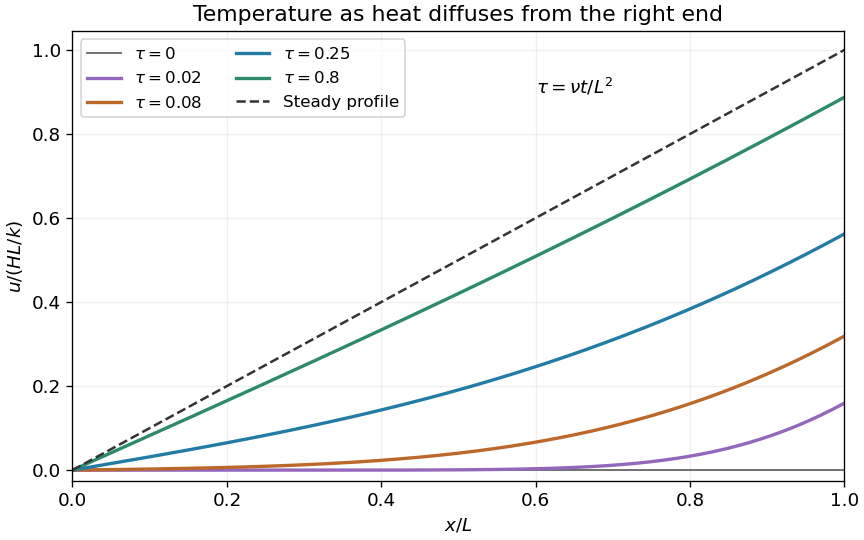
Heating a bar through one end while the other end stays at zero temperature
. Original dimensionless temperature profiles at several diffusion times. The eventual linear profile has the imposed unit derivative at the heated end. Details.
New to topics? Read the docs here!