Solution
ID: past-exam-of-the-mathematics-course-of-the-year-2-of-the-natural-sciences-course-of-the-university-of-cambridge/2010/paper-1/9/solution
Past exam of the mathematics course of the year 2 of the natural sciences course of the University of Cambridge 2010 Paper 1 9 Solution by  Codex 0 2026-10-18
Codex 0 2026-10-18For fixed endpoint values, the Euler-Lagrange equation is . Along a stationary curve, the chain rule givesWhen , the Beltrami identity therefore takes the requested sign convention
By Fermat principle, the elapsed-time integrand for the given speed is . ThusThe constant is negative for a finite regular ray. Squaring gives . At a maximum height , the slope is zero, so . HenceSeparate variables on either side of the turning point. Integration gives the parabolic light rays in a reciprocal-square-root speed profileThe quadratic opens downwards, with its greatest height at . The positive index condition holds throughout the layer because . Vertical rays are a separate zero-horizontal-momentum case, outside the regular graph representation ; they are not returning rays of the type considered below.
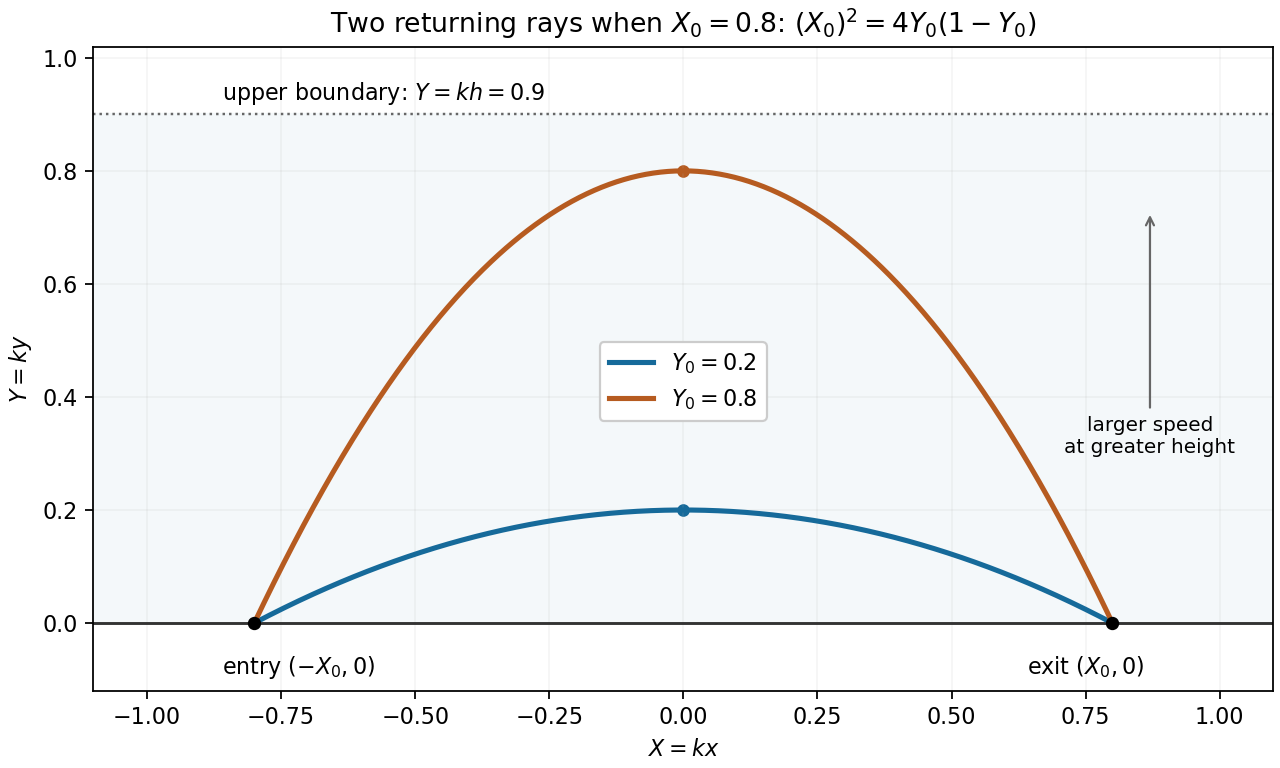
Equal endpoint heights at force . Setting givesFor nonzero separation, a real returning ray requires and has candidate turning heightsOnly choices satisfying are rays wholly within the specified layer. Depending on its thickness there may be two, one, or no admissible choices; at zero discriminant the two algebraic candidates coincide. The entry and exit points at are interpreted as limiting boundary points of the open medium.

New to topics? Read the docs here!