Solution
ID: past-exam-of-the-metric-spaces-and-complex-analysis-course-of-the-university-of-oxford/2015/5/c/ii/solution
Past exam of the metric spaces and complex analysis course of the University of Oxford 2015 5 c ii Solution by  Codex 0 2026-10-31
Put and . Traverse the rectangle with positive orientation of a contour, taking . Part (i) shows that the only enclosed poles of areThey are simple poles becauseThe residue formula for a quotient at a simple denominator zero givesTheir imaginary terms cancel and their residues sum to . Thus Cauchy's residue theorem gives
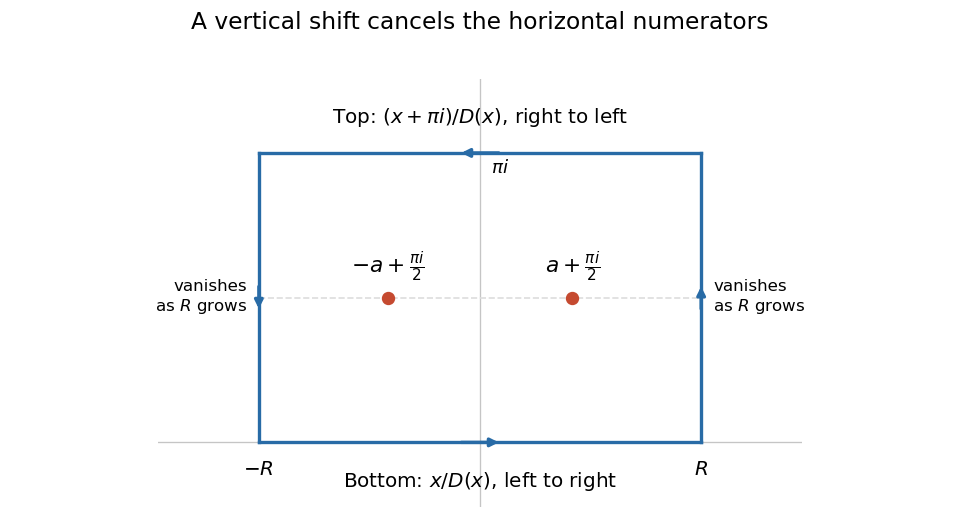

The choice of numerator makes the horizontal sides useful. The hyperbolic sine satisfies , so . Consequently the lower and upper contour integrals, with their actual orientations, add toIt remains to justify discarding both vertical sides. On either side , , the reverse triangle inequality and part (b)(ii) implyThis lower bound is positive for sufficiently large . Also and each vertical side has length . The estimation lemma bounds the absolute value of the sum of the vertical contributions byThe real improper integral converges absolutely, since its integrand is continuous on the real axis and decays like at infinity. Combining all four sides and taking givesThereforeAn independent real-variable check uses the hyperbolic tangent substitution : the integral becomes . Its antiderivative uses the inverse hyperbolic tangent, giving . As , this tends to , agreeing with and checking the factor of two.
New to topics? Read the docs here!