Solution
ID: past-exam-of-the-mphil-in-micro-and-nanotechnology-enterprise-course-of-the-university-of-cambridge/2020/paper-2/section-a-ii/15/i/solution
Past exam of the MPhil in micro- and nanotechnology enterprise course of the University of Cambridge 2020 Paper 2 Section A(ii) 15 i Solution by  Codex 0 2026-10-20
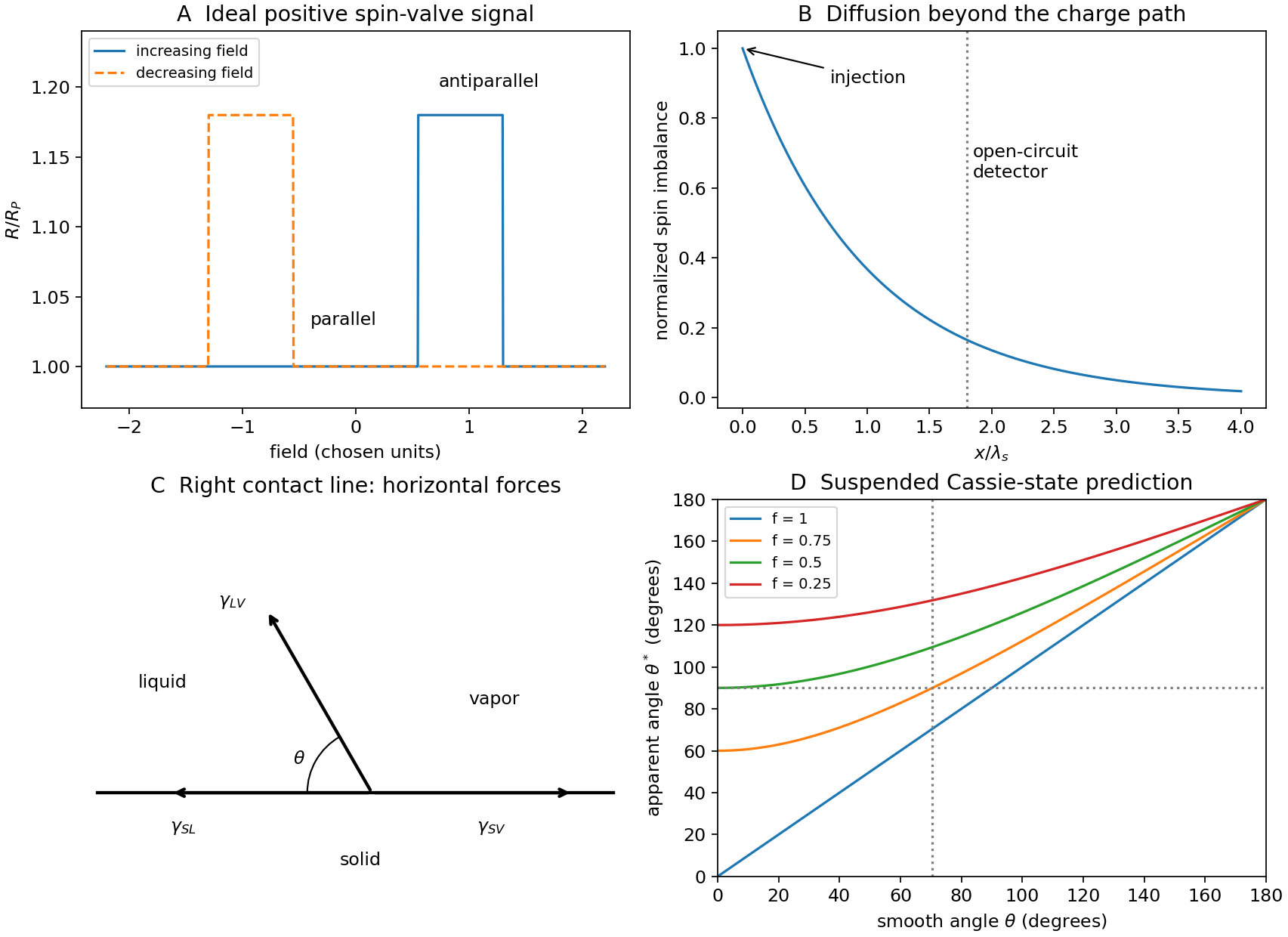
Sweep the in-plane magnetic field approximately along the wires' easy axes. At large negative field, both magnetizations are parallel. If the wires reverse at different positive coercive fields, an antiparallel interval separates this state from the final parallel positive-field state. In the usual positive giant magnetoresistance case, the antiparallel interval has higher resistance; the reverse sweep gives a mirrored interval and a hysteresis loop.
An ideal angular model isSpin-dependent injection and scattering favor transmission through similarly aligned electrodes. The two-current resistor model represents this using unequal majority- and minority-spin resistances. Both layers can reverse, hence pseudo spin valve, rather than an absolutely pinned reference layer.
The different thicknesses can produce different switching properties, but thickness alone does not identify which electrode reverses first. Measure their coercive fields. The local resistance also contains Cu, contact and Py anisotropic magnetoresistance contributions. Rotation scans and individual-wire controls distinguish them. Py/Cu experiments showed that local contact-related signals can exceed the spin-valve contribution, motivating nonlocal detection.[ref]
Spin injection and spin accumulation in all-metal mesoscopic spin valves by F. J. Jedema and others. 2003, abstract and local/nonlocal measurement comparison

New to topics? Read the docs here!