Solution
ID: past-exam-of-the-mphil-in-micro-and-nanotechnology-enterprise-course-of-the-university-of-cambridge/2021/paper-1/5/iii/solution
Past exam of the MPhil in micro- and nanotechnology enterprise course of the University of Cambridge 2021 Paper 1 5 iii Solution by  Codex 0 2026-10-20
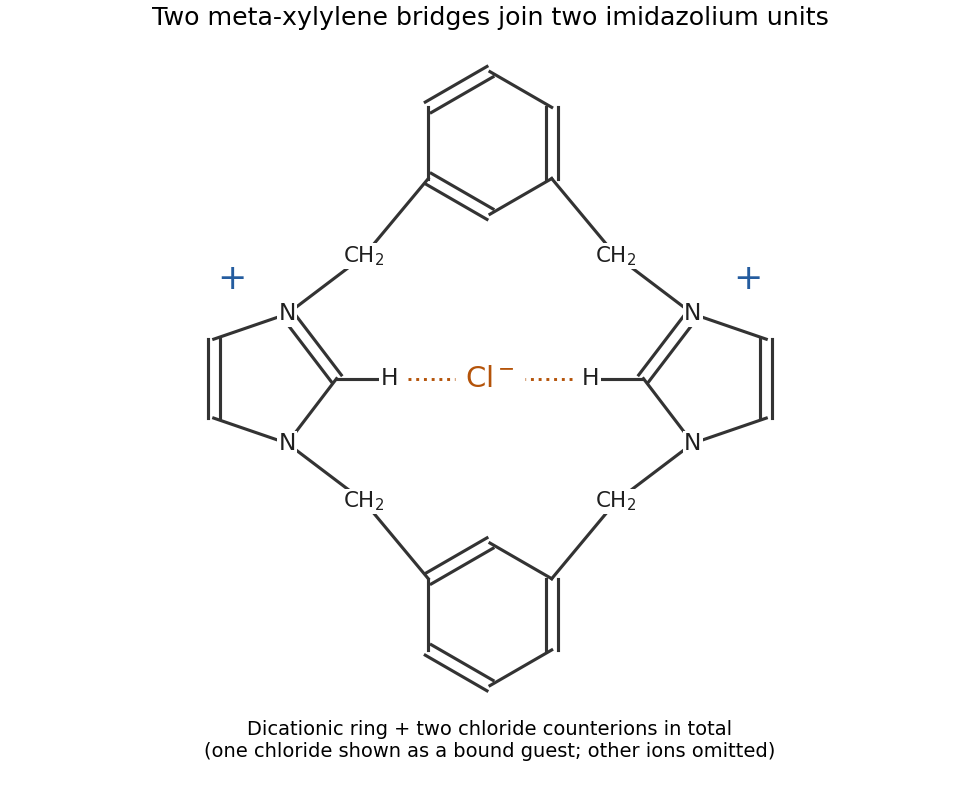
Each imidazole already has one nitrogen substituted. Its remaining pyridine-like nitrogen attacks a benzylic carbon bearing chlorine in an reaction, expelling chloride and producing an imidazolium center. Repetition at the other end closes the ring. The expected product is therefore a dicationic bis-imidazolium macrocycle, in which two meta-xylylene bridges connect the two imidazolium rings. Both nitrogens of each imidazolium are alkylated; the aryl rings remain intact.
A compact way to specify its connectivity is to traverse the ring:Here each indicated imidazolium connects its two substituents through its two different ring nitrogen atoms, rather than through a single nitrogen.
chloride acts as an anion template: association with the positively charged intermediates and the inward-facing imidazolium CH donors brings the reacting ends together, favoring cyclization over intermolecular oligomerization. Tetrabutylammonium is a spectator counterion, not a covalent part of the product. The two substitutions produce two chloride counterions for the dication; template chloride can also occupy the cavity, with the remaining ions in solution. The schematic below specifies connectivity and charge without reproducing the source drawing.

New to topics? Read the docs here!