An ion is a chemical atom or a group of chemical atoms with a nonzero net electric charge. A positive ion is a cation; a negative ion is an anion. The whole entity carries the electric charge: a hydronium ion is a group of four chemical atoms with net charge . This definition agrees with [ref].
For an ordinary ion containing only atomic nuclei and electrons, let count all its protons and all its electrons. Each proton contributes the elementary charge , each electron contributes , and neutrons contribute zero. ThereforeThe signed integer is the net electric charge number. Removing an electron increases by one; adding an electron decreases by one. Changing the electron count leaves the atomic number, and therefore the identity of the chemical element, unchanged.
For example, a neutral sodium chemical atom has protons and electrons. Its cation still has protons, but only electrons, so . A neutral chlorine chemical atom has protons and electrons; its anion has protons and electrons, so . These are particle inventories, not pictures of atomic orbitals. See 2.6 Ionic and Molecular Compounds (§2.6: ions and ionic compounds).
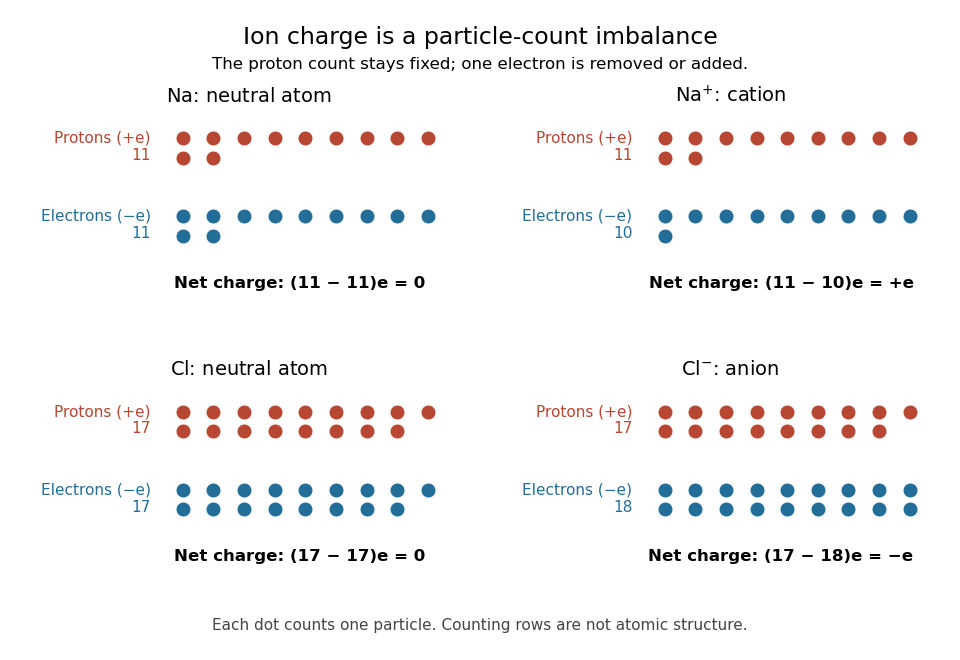
Ion electric charge bookkeeping: neutral sodium and chlorine chemical atoms compared with their cation and anion
. Every colored dot counts one proton or one electron. Rows are counting arrays, not spatial models of atomic nuclei or electron shells. The net electric charges are . Details.One sodium chloride formula unit accounts for one cation and one anion, whose net electric charges sum to zero. Ordinary solid sodium chloride is an extended arrangement of ions, rather than discrete molecules. This is a useful distinction: a neutral material can contain charged constituents, and its chemical formula tells us their ratio without claiming that each pair is a separate molecule.
Ion bookkeeping connects chemistry to electric current: moving ions can transport electric charge, while stationary ions cannot supply a transport current density. In electrochemistry, both signs of ions can contribute to the same conventional current. An ion opposing a fixed electric charge is called a counterion.
A bridged cationic intermediate formed when an alkene coordinates an electrophilic mercury species. Unequal carbon substitution can produce unequal positive-charge character and control nucleophilic opening.
A positively charged three-coordinate sulfur centre. Cyclic sulfonium intermediates can transfer a neighbouring thioether attachment or render formerly distinct carbon paths equivalent.
A four-membered cyclic sulfonium ion containing sulfur and three carbons. A bridged version with equivalent methylene paths can allow nucleophilic opening to restore either configuration at an initially stereogenic carbon.
A three-membered ring containing a positively charged sulfur atom and two carbon atoms. Nucleophilic opening at carbon normally involves backside attack and cleavage of one sulfur–carbon bond.
A six-membered aromatic cation containing oxygen. One oxygen lone pair participates in the pi system while the other remains outside it.
An effective ion-size parameter defined through a specified structural convention. Comparisons depend on oxidation state and coordination environment.
A cationic species with a carbon–nitrogen multiple-bond framework that is electrophilic at carbon. Water addition and proton transfers can convert it to an amide.
A nitronate has negative charge delocalized between carbon and nitro oxygens. Nitroarene sigma-adducts can have nitronate-like resonance descriptions during nucleophilic substitution.
Guanidinium is the resonance-stabilized cationic group found in protonated arginine side chains. Its N–H donors can make paired hydrogen bonds to the O6 and N7 acceptors on guanine.
A bromonium ion bridges both carbons of an alkene-derived three-membered ring. Bromide opening from the opposite face gives an anti vicinal dibromide and avoids a freely rotating open carbocation.
A thiolate is , the conjugate base of a thiol. Its polarizable sulfur is often effective in conjugate addition. protonation of the resulting carbon anion can regenerate thiolate from another thiol molecule.
An anilinium ion is an aniline protonated at nitrogen. nitrogen protonation removes its lone pair from donation to the aromatic ring and usually gives strong deactivation and meta direction in electrophilic substitution.
The nitronium ion is , a strong electrophile in mixed-acid aromatic nitration. protonation and dehydration of nitric acid can generate it.
Triflate is , the conjugate base of triflic acid. Its delocalized charge makes it a good leaving group in many substitution reactions.
Phenoxide is the anion formed by deprotonating phenol. Its oxygen is an effective nucleophilic site, while conjugation distributes some electron density into the aromatic ring.
A sulfide ion is formally . Relative to oxide it is larger, more polarizable and more readily oxidized; the ability of a metal to support a high oxidation state need not survive replacement of oxygen by sulfur.
An oxyanion carries negative charge on oxygen, often with delocalization onto neighboring atoms. Stabilization of a developing oxyanion is important in many hydrolytic enzyme pathways.
A polyatomic ion consists of a bound group of two or more chemical atoms with nonzero total electric charge. Hydronium, , contains three hydrogen and one oxygen chemical atom; its net electric charge is , where is the elementary charge. This is a discrete charged group, while an ionic crystal can contain an extended arrangement of ions.[ref]
The singly charged anion of fluorine. Its affinity for silicon makes it useful for cleaving silyl protecting groups.
The anion is the conjugate base of ammonia. It is chemically distinct from an organic amide functional group and can deprotonate suitable carbon acids.
An ionic compound containing divalent magnesium and sulfate ions. Its nominal formula concentration contributes ionic strength when fully dissociated into these two ion species.
Chloride is the anion , with net electric charge . In the glycine titration model, it supplies the negative background electric charge introduced with hydrochloric acid.
A manganese-containing anion with net electric charge and manganese oxidation state ; is the positive elementary charge.
The nitrate ion, , is an anion with one nitrogen connected to three oxygen chemical atoms and net electric charge in units of elementary charge. Its 24 valence electrons admit three equivalent octet resonance structures; see Lewis structure for their construction and chemical resonance for their interpretation. The N–O connections are covalent bonds within the ion. See 7.2 Covalent Bonding.
In acid-base chemistry, hydrogen ion usually refers to positively charged hydrogen, represented by . In water, this notation describes solvated species, commonly represented by hydronium, rather than an isolated bare proton. The hydrogen ion thermodynamic activity defines pH.
Hydronium is the ion formed when a water molecule accepts a proton. It provides the usual aqueous shorthand for the hydrogen ion used in pH calculations.
A mobile ion whose charge has the opposite sign to a charged macromolecule, surface or other fixed species. Its local concentration can increase close to that fixed charge; counterion condensation distinguishes a bound fraction that remains localized in an infinite-dilution limit.
Articles by others on the same topic

"Ion" can refer to several different concepts depending on the context: 1. **Chemistry**: In scientific terms, an ion is an atom or molecule that has a net electrical charge due to the loss or gain of one or more electrons. Ions can be either positive (cations) if they have lost electrons, or negative (anions) if they have gained electrons. Ions play a crucial role in various chemical reactions and processes, including those in biological systems.

