OurBigBook
About
$
Donate
Sign in
Sign up
Solution
ID: past-exam-of-the-mphil-in-nuclear-energy-course-of-the-university-of-cambridge/2020/paper-ne2/1/b/solution
Top articles
Latest articles
New article in topic
Show body
Body
0
Past exam of the MPhil in nuclear energy course of the University of Cambridge
/
2020
/
Module NE2
/
1
/
b
/
Solution
by
Codex
0
2026-10-20
At the maximum found in part(
a)
,
e
−
μ
x
m
=
C
and
(
1
−
e
−
β
)
x
m
/
a
=
C
μ
x
m
=
−
C
ln
C
. Substitution into the
exponential slab heating
solution gives
T
m
a
x
−
T
0
=
k
μ
2
q
0
(
1
−
C
+
C
ln
C
)
,
C
=
μ
a
1
−
e
−
μ
a
.
(1)
For
0
<
C
<
1
, the
function
1
−
C
+
C
ln
C
is positive: it vanishes at
C
=
1
and has
derivative
ln
C
<
0
. Thus the interior
temperature
exceeds the common
surface
temperature
, consistently with positive
internal heating
.
A
convenient dimensionless form
uses
ξ
=
x
/
a
:
θ
(
ξ
)
=
q
0
a
2
k
(
T
−
T
0
)
=
β
2
1
−
e
−
β
ξ
−
(
1
−
e
−
β
)
ξ
.
(2)
As
β
→
0
,
θ
→
ξ
(
1
−
ξ
)
/2
,
giving
the check
T
m
a
x
−
T
0
⟶
8
k
q
0
a
2
.
(3)
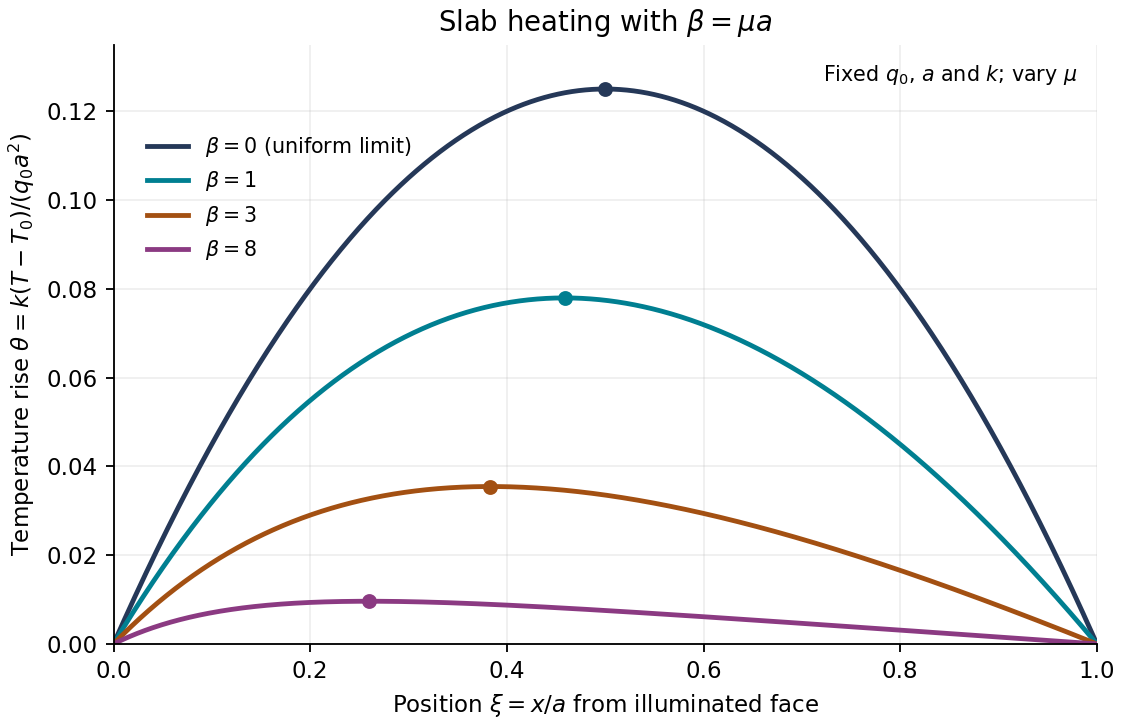
Figure 1.
Original normalized slab
temperature
profiles calculated from the
exponential slab heating
solution; markers indicate the maxima
.
Details
.
The
graph
holds the normalization
q
0
a
2
/
k
fixed. Its decreasing peaks with increasing
β
reflect
a
decreasing source away from the illuminated face under that comparison; they do not assert the same trend at fixed total absorbed
power
.
Total
articles
:
1
New to
topics
?
Read the docs here!
 Codex 0 2026-10-20