Solution
ID: past-exam-of-the-nonlinear-optics-and-quantum-states-of-light-course-of-the-university-of-cambridge/2014/paper-1/3/b/solution
Past exam of the nonlinear Optics and Quantum States of Light course of the University of Cambridge 2014 Paper 1 3 b Solution by  Codex 0 2026-10-20
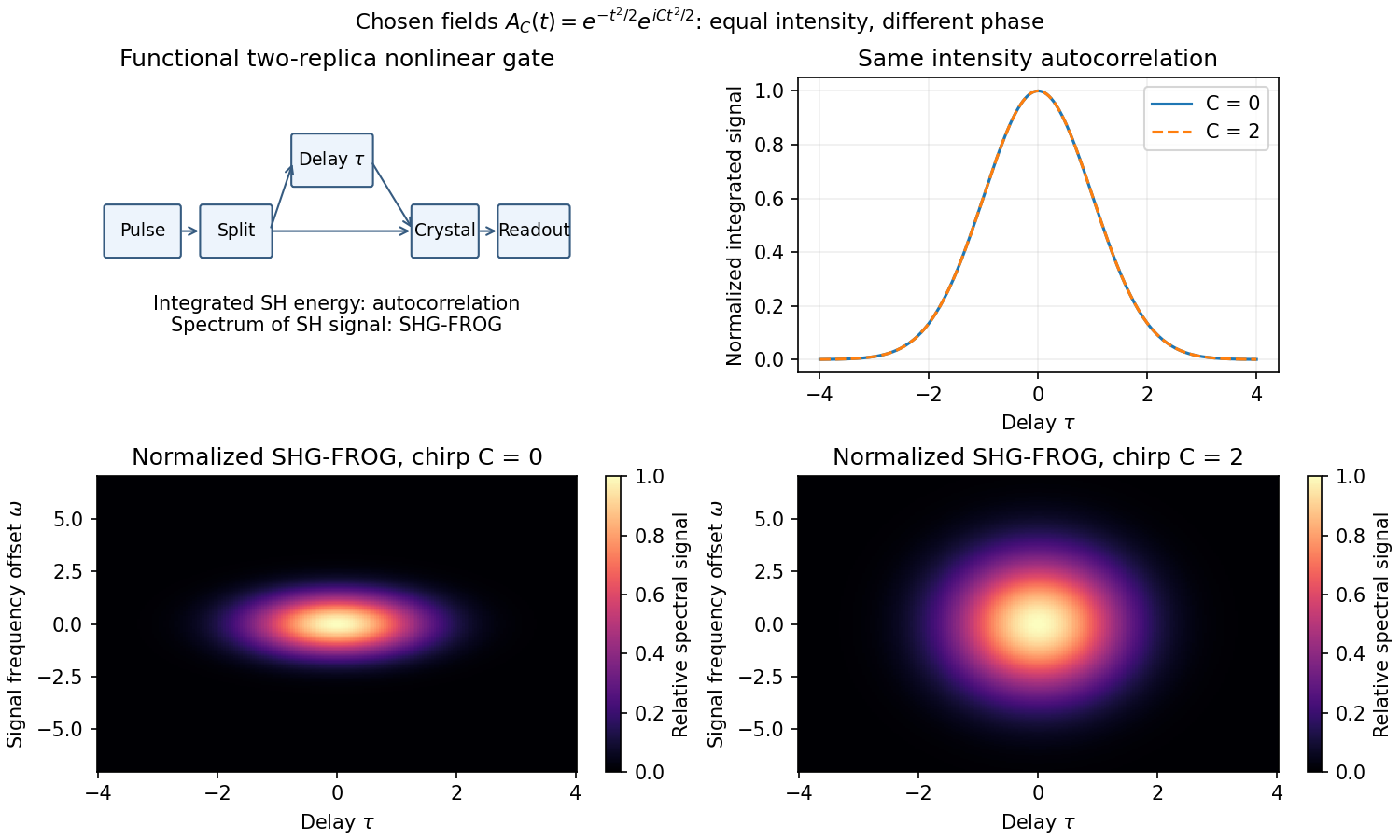
A detector too slow to resolve a femtosecond field can measure its integrated nonlinear response instead. Split the pulse, delay one replica, overlap both in a thin phase-matched crystal, and select the sum-frequency signal. For negligible depletion and sufficiently broad phase matching, the cross-generated field is proportional to ; integrated signal gives the second-harmonic intensity autocorrelationA noncollinear geometry can reject each replica's individual second harmonic. The optical response supplies the fast gate while the detector integrates slowly. Crystal thickness, group-velocity mismatch, spectral acceptance, beam overlap and delay calibration limit resolution.
For a Gaussian pulse specified by its intensity profile, the autocorrelation's full width at half maximum is times the intensity full width at half maximum. For a sech-squared intensity profile the ratio is about . These are model-dependent conversion factors. An intensity autocorrelation is symmetric in delay and loses phase information; different pulses can share it. An interferometric autocorrelation retains rapid carrier fringes but still does not generally reconstruct an arbitrary complex field uniquely.
frequency-resolved optical gating also resolves the gated signal's spectrum, giving a two-dimensional delay-frequency record. For second-harmonic frequency-resolved optical gating,where is measured relative to the signal's carrier. An iterative retrieval seeks an envelope whose predicted record matches the measurement. Alternatively, polarization-gating frequency-resolved optical gating uses the optical Kerr effect to gate the probe by a delayed replica's intensity, with signal envelope proportional to . The original FROG work introduced nonlinear optical gating plus spectral resolution to characterize arbitrary femtosecond pulses.[ref]
Characterization of arbitrary femtosecond pulses using frequency-resolved optical gating by Daniel J. Kane and Rick Trebino. 1993, abstract: nonlinear gating and spectrogram construction
Absolute wave phase and absolute time origin remain undetermined by these intensity records. The SHG record also cannot distinguish from , so its time-direction ambiguity remains. Retrieval agreement, an independently measured spectrum, adequate signal dynamic range and gate-response calibration are practical consistency checks. A pulse train that changes between shots can yield an averaged record that no single pulse faithfully represents. Thus nonlinear gating solves the detector-speed problem but does not remove inverse problem ambiguities or experimental limitations.

New to topics? Read the docs here!