
The dynamic range of a measurement procedure is the ratio between the largest and smallest positive inputs it can usefully distinguish under specified conditions. The quantity, bandwidth, observation interval, measurement calibration and acceptance criteria must accompany the number. An upper boundary might be set by amplifier clipping, while a lower boundary might require a specified signal-to-noise ratio. More displayed digits do not by themselves establish either boundary or better measurement precision.
Consider a photodiode responsivity measurement in which a photodiode produces electric current from optical power , with spectral responsivity in amperes per watt. A transimpedance amplifier with transimpedance produces an output electric potential difference , where is expressed in volts per watt. If a chosen detection criterion is times the root mean square output noise , and the linear output ceiling is , the noise-limited dynamic range isIncreasing shifts this input interval toward smaller optical power; it does not enlarge its ratio when the stipulated output noise and output ceiling remain fixed. The corresponding input-referred noise is .
An original numerical example makes the distinction concrete. Stipulate in either setting, , , and no other limiting effect. A high-sensitivity setting covers to ; a lower-sensitivity setting covers to . Each interval has . With compatible measurement calibration and range-overlap calibration in their common interval, gain ranging covers a contiguous union from to : . These are optical power ratios, so their values in decibels are , approximately and respectively.
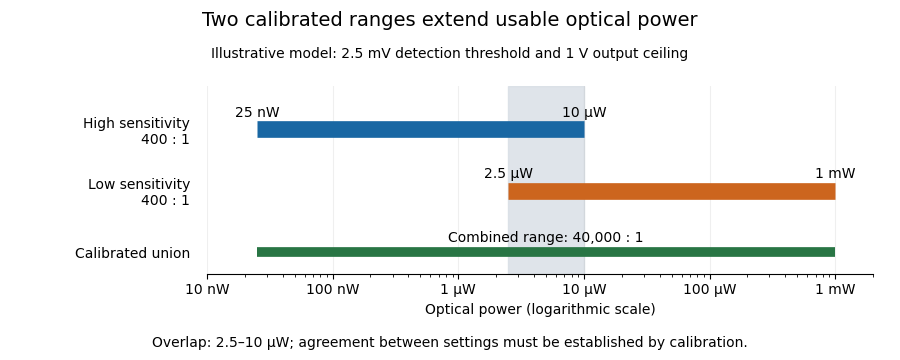
Two calibrated optical-power ranges cover a wider continuous interval
. Original illustrative ranges with the same stipulated output noise and ceiling. The shaded interval is available for checking agreement between gain settings. Details.The equal-noise assumption isolates the geometric effect of gain ranging; it is not a specification for an actual instrument. A real transimpedance amplifier changes several properties together: its feedback network affects bandwidth, noise and allowable input electric current. The DLPCA-200 manufacturer sheet shows a current-to-voltage converter followed by programmable amplification and gives separate tables for these dependencies.[ref] To test a combined dynamic range, vary a stable light source through the overlap, compare the two estimates of optical power, and allow the output to settle after switching. Agreement within the required measurement uncertainty is evidence that the two ranges can be joined; the mere presence of two gain switches is insufficient.


Dynamic range refers to the difference between the smallest and largest values of a signal that a system can effectively handle or reproduce. It is commonly used in various fields, including audio, photography, and electronics, to describe the range of values over which a system can operate without distortion or loss of quality. In more specific terms: 1. **Audio**: Dynamic range is the difference between the softest and loudest sound that can be captured or reproduced in a recording or playback system.
New to topics? Read the docs here!