Solution
ID: past-exam-of-the-optics-and-electrodynamics-course-of-the-university-of-cambridge/2013/paper-1/2/b/solution
Past exam of the optics and electrodynamics course of the University of Cambridge 2013 Paper 1 2 b Solution by  Codex 0 2026-10-20
Sunlight is approximately unpolarized before its interaction with the environment. For Rayleigh scattering by small isotropic scatterers, the induced electric dipoles radiate only their components transverse to the viewing direction. For unpolarized incident light scattered through angle , the perpendicular and parallel intensities are proportional to 1 and . The degree of linear polarization is thereforeAt single scattering is fully linearly polarized perpendicular to the scattering plane. This explains the polarized sky away from the Sun; multiple scattering and aerosols reduce the ideal contrast.
Reflection at a dielectric surface treats the two linear polarizations differently. At Brewster incidence, , the reflected p component vanishes for ideal transparent nonmagnetic media. The remaining reflected glare is s polarized, perpendicular to the incidence plane, approximately horizontal for a horizontal water surface. Away from this angle the reflection is generally partially polarized. The transmitted beam also has unequal s/p transmission.
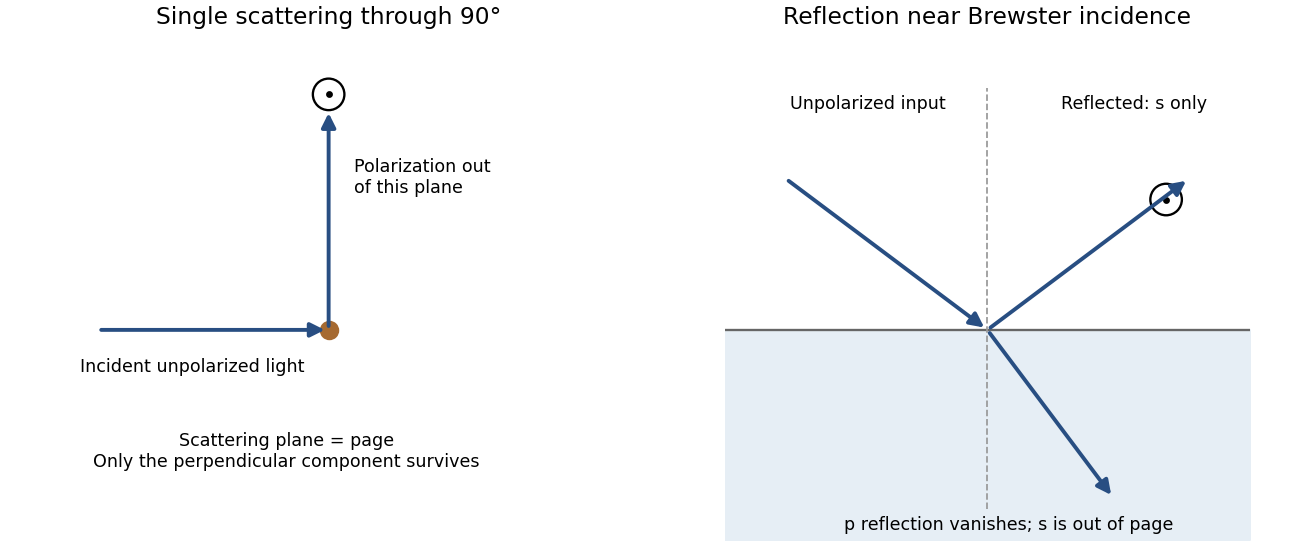
Original diagrams of polarization perpendicular to a single-scattering plane and of s-polarized reflection near Brewster incidence at a dielectric surface
. Details. 
Refraction and internal reflection in water droplets likewise have polarization-dependent Fresnel coefficients, producing strong linear polarization in rainbow light. These are generic scattering and boundary-condition mechanisms; no biological detection mechanism is required.
New to topics? Read the docs here!