Rayleigh scattering is elastic scattering of electromagnetic radiation by particles much smaller than the incident wavelength. In the stationary particle approximation, the scattered electromagnetic radiation keeps the incident frequency: its direction changes, rather than its color. The incident electric field induces an oscillating electric dipole moment, which produces electric dipole radiation. This is a useful example of how a microscopic response can explain a familiar large-scale sight, why the sky is blue. [ref]
https://farside.ph.utexas.edu/teaching/jk1/lectures/node108.html. Richard Fitzpatrick, Rayleigh Scattering: bound-charge response and wavelength dependence
.The smallness condition for Rayleigh scattering by a small sphere of radius is , where the wavenumber is and is the surrounding medium's wavelength. For ordinary materials with modest refractive index, the incident electric field then varies little across the particle, making the electric-dipole approximation for radiation useful. For very large refractive index, also check the internal size before applying the simple electric dipole model. Once these conditions fail, use Mie scattering for a sphere instead of extrapolating the Rayleigh scattering wavelength dependence.
Historically, the 1871 paper [ref]
https://en.wikisource.org/wiki/Scientific_Papers/Volume_1/On_the_Light_from_the_Sky,_Its_Polarization_and_Colour. Rayleigh, On the Light from the Sky, Its Polarization and Colour: original-paper transcription
connected the color and polarization of an electromagnetic wave of scattered skylight with particles smaller than the wavelength. Its dimensional analysis anticipates scattered light intensity proportional to particle volume squared and to . The original mechanical picture is historical; the modern explanation uses induced electric dipole radiation.Consider a fixed, homogeneous, nonabsorbing, nonmagnetic sphere of radius in vacuum. Let be its relative refractive index, a fixed real number; in vacuum this equals the sphere's refractive index. Treat as independent of wavelength over the range being compared, neglecting optical dispersion. Air can be approximated by vacuum here because its refractive index is close to one. These assumptions describe a toy particle, rather than a literal model of an individual air molecule.
The Rayleigh scattering cross-section is an effective area: the total scattered power is , where is the incident light intensity. For its leading approximation isThe units are area, since has units . This Rayleigh scattering cross-section measures scattering, not conversion of the incident electromagnetic radiation into heat. The definition follows [ref]
https://farside.ph.utexas.edu/teaching/jk1/lectures/node107.html. Fitzpatrick, Thomson Scattering: total and differential scattering cross-sections
.To see the mechanism, the nearly uniform applied electric field produces an electric dipole moment with peak magnitudewhere is the incident electric field peak wave amplitude and is vacuum permittivity. This is the sphere's response in electrostatics, with its permittivity divided by vacuum permittivity equal to under the nonmagnetic assumption. [ref]
https://farside.ph.utexas.edu/teaching/jk1/lectures/node42.html. Fitzpatrick, Boundary Value Problems with Dielectrics, equation 554: induced sphere dipole
. The averaged electric dipole radiation power is , with angular frequency and speed of light . Dividing by gives the displayed Rayleigh scattering cross-section. Thus doubling radius multiplies the electric dipole moment by eight and the scattered power by , provided the larger sphere still satisfies . [ref]https://farside.ph.utexas.edu/teaching/em/lectures/node95.html. Fitzpatrick, Electric dipole radiation: angular power and its integral
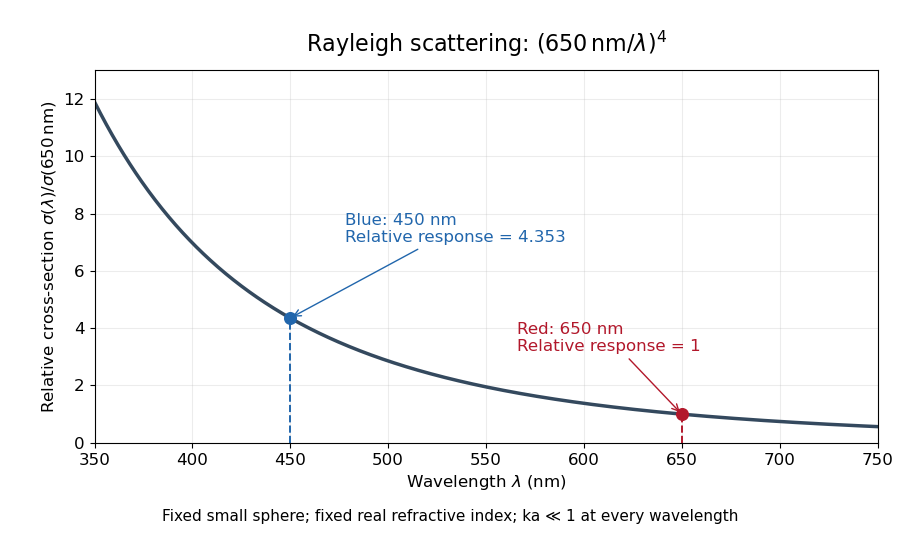
.For a fixed sphere and fixed refractive index, both the Rayleigh scattering cross-section and scattering efficiency are proportional to . Halving wavelength multiplies either by , as long as the shorter wavelength still satisfies . If optical dispersion changes , the material factor changes too; the pure fourth-power comparison then needs correction.
For equal incident light intensities at blue wavelength and red wavelength , the same toy sphere givesBlue light therefore produces about times the scattered power. This compares the particle's response at two wavelengths; it does not assert that an actual sky has this ratio of observed blue and red light intensities.
For incident unpolarized light and the isotropic electric dipole response of Rayleigh scattering by a small sphere, let be the angle between the incident beam's propagation direction and the outgoing direction. The differential scattering cross-section and its relative angular pattern arewhere is an element of solid angle. Averaging over the two transverse directions of incident polarization of an electromagnetic wave gives this pattern. Forward scattering at and backward scattering at are equally strong: . Sideways scattering at is weakest, but nonzero: . [ref]
https://farside.ph.utexas.edu/teaching/jk1/lectures/node107.html. Fitzpatrick, Thomson Scattering, equations 1283–1287: averaging the dipole angular pattern
.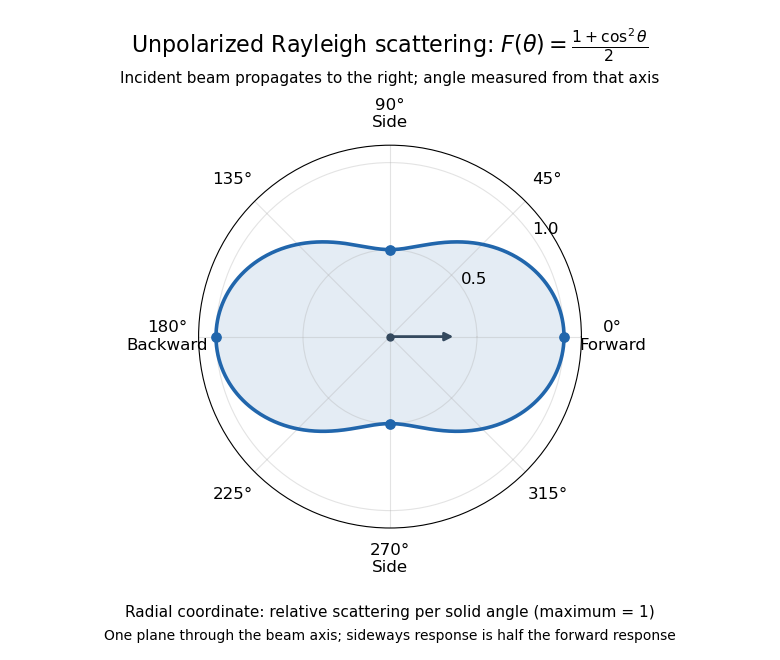
Rayleigh scattering angular pattern for incident unpolarized light, measured from the incident beam
. The plotted radial coordinate is , a relative differential scattering cross-section, rather than the distance travelled by light. The incident propagation axis points right: is forward, backward, and sideways. Rotating this plane about the incident axis gives the three-dimensional pattern. Details.The normalization is consistent becauseThus integrating gives the total Rayleigh scattering cross-section . The plotted has maximum one; it is not itself normalized to unit solid angle integral.
For a single electric dipole driven by incident linear polarization, the angular distribution of electric dipole radiation instead has a factor, where is measured from the electric dipole moment direction, parallel to the incident electric field. That direction is perpendicular to the incident beam. Confusing with the beam angle would incorrectly predict zero forward scattering. Averaging the dipole patterns over incident unpolarized light yields the displayed .
In a clear terrestrial atmosphere, Rayleigh scattering by air molecules redirects some sunlight toward an observer looking away from the Sun. Shorter wavelengths are preferentially scattered, enriching the scattered light in blue compared with the incoming sunlight. Along the longer atmospheric path to the low Sun, more short-wavelength light is removed from the direct beam, helping produce red sunsets. [ref].
Violet light has an even shorter wavelength than blue light, so the Rayleigh scattering wavelength dependence alone cannot predict the perceived sky color. The incoming solar optical spectrum and the eye's differing response to wavelengths both matter; human vision is less sensitive to violet than to blue. [ref]
https://www.weather.gov/fgz/SkyBlue. NOAA National Weather Service, Why Is The Sky Blue?: solar spectrum and visual response
. Multiple scattering and other atmospheric particles also affect the observed sky. Cloud droplets are generally too large for this simple Rayleigh scattering model: Mie scattering describes spherical droplets, with much weaker visible wavelength selectivity, while repeated scattering helps make clouds appear white. [ref]https://www.giss.nasa.gov/edu/icp/research/ppa/1997/reyes/. NASA GISS, Aerosols in the Atmosphere: particle size, Mie scattering and white clouds
. Articles by others on the same topic



Rayleigh scattering is a phenomenon in which light or other electromagnetic radiation is scattered by particles that are much smaller than the wavelength of the light. Named after the British scientist Lord Rayleigh, who studied this effect in the 19th century, it explains why the sky appears blue during the day and can also contribute to the colors observed in sunsets and sunrises. The scattering occurs when light interacts with molecules in the atmosphere, such as nitrogen and oxygen.