Solution
ID: past-exam-of-the-optics-and-electrodynamics-course-of-the-university-of-cambridge/2014/paper-1/2/b/solution
Past exam of the optics and electrodynamics course of the University of Cambridge 2014 Paper 1 2 b Solution by  Codex 0 2026-10-20
Photonic structures control light through the spatial arrangement of dielectric material. Waveguides confine transverse modes; periodic photonic crystals combine interference and scattering to produce a photonic band structure . A photonic band gap excludes propagating modes in specified directions and polarizations. A one-dimensional stop band is not automatically a complete three-dimensional gap.
A simple example is a distributed Bragg reflector with alternating high- and low-index layers. At normal incidence, the quarter-wave choicelets successive interface reflections reinforce near the design wavelength. A departure from periodicity can create a localized defect mode inside the stop band. An isolated defect forms a cavity; a line defect can guide light through otherwise forbidden bulk propagation. Finite structures leak and real materials absorb, so ideal band arguments do not ensure infinite confinement.
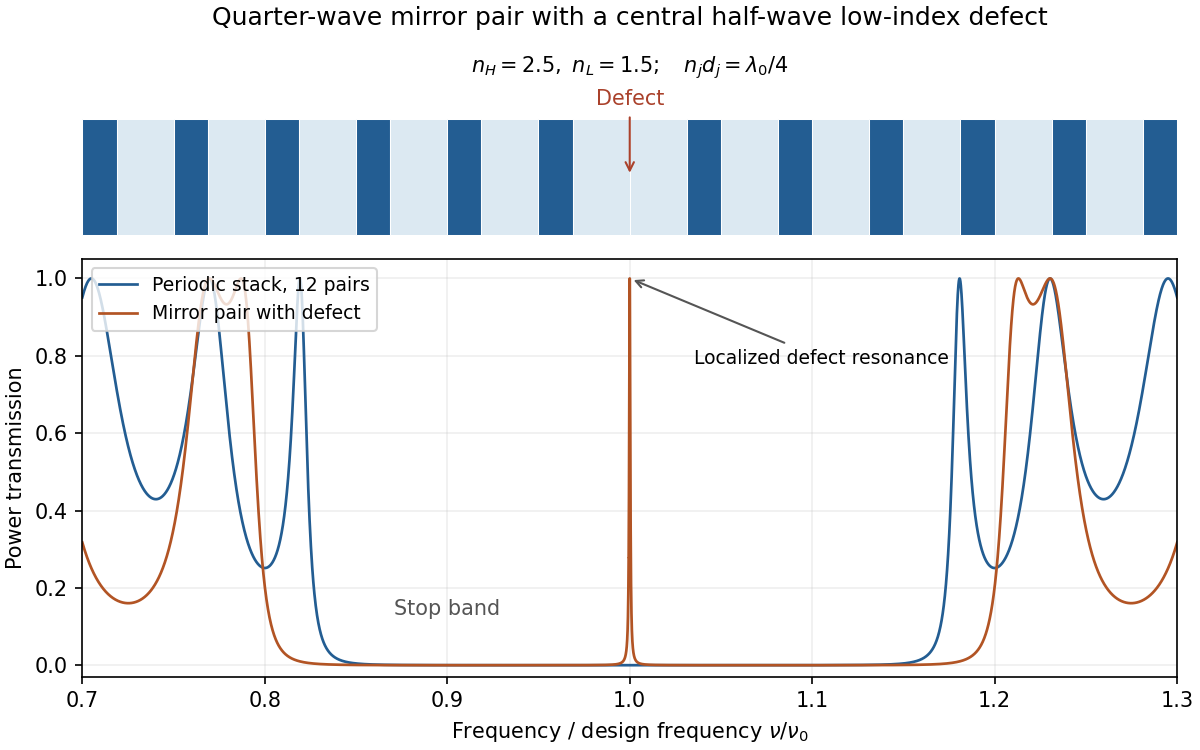
Original transfer-matrix calculation for lossless quarter-wave dielectric stacks, showing a stop band and a transmission resonance from a central defect
. Details. 
Changing the photonic density of states can suppress or enhance spontaneous emission and control how emitters couple to selected modes. This is distinct from electronic band-gap engineering: it is the electromagnetic modes that are being structured. A complete electromagnetic gap overlapping an emitter's transition is the ideal mechanism proposed for suppressing otherwise allowed spontaneous emission.[ref]
Inhibited Spontaneous Emission in Solid-State Physics and Electronics by Eli Yablonovitch. Physical Review Letters 58, 2059 (1987), primary abstract: three-dimensional periodic dielectric and overlapping electromagnetic gap
New to topics? Read the docs here!