Solution
ID: past-exam-of-the-options-i-course-of-the-university-of-oxford/2010/h/h1/solution
Past exam of the options I course of the University of Oxford 2010 H H1 Solution by  Codex 0 2026-10-31
Expand about the equilibrium and keep only terms quadratic in displacement and velocity. Writing and , the linearized Lagrangian is , up to a constant. Its equations are . With positive-definite mass matrix , the normal frequencies and mode vectors solveFor a nondegenerate stable equilibrium, is positive definite and all these frequencies are positive. A zero eigenvalue indicates a zero-frequency linearized mode requiring higher-order analysis if nonlinear stability is in question.
The three spring extensions are , and . HenceThe matrices are and . The two independent modes areIn the first mode both masses move together with equal displacement, leaving the middle spring unchanged. In the second they move in opposite directions with equal magnitude; the midpoint stays fixed and the middle spring changes length by twice either displacement. Arbitrary small motion is a superposition of sinusoidal motions in these two modes.
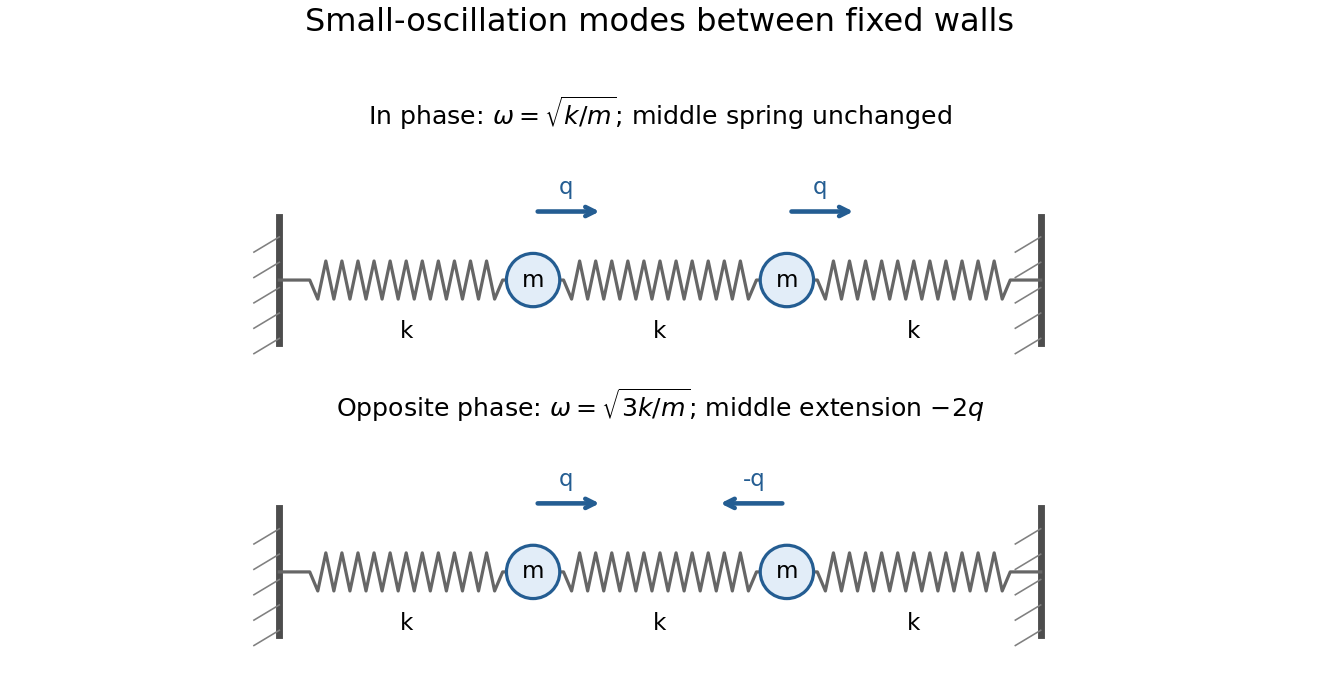

These are the normal modes of two equal masses between three springs.
New to topics? Read the docs here!