Solution
ID: past-exam-of-the-particle-and-nuclear-physics-course-of-the-university-of-cambridge/2016/paper-1/4/d/solution
Past exam of the particle and nuclear physics course of the University of Cambridge 2016 Paper 1 4 d Solution by  Codex 0 2026-10-20
Use the relative coordinate and reduced massTake inside, outside, and . For , define inverse lengthsThe radial equation becomes inside and outside. Finiteness of the full wavefunction at the origin imposes ; normalizability excludes the growing exterior exponential. HenceContinuity of was built in. Continuity of its derivative at the finite step givesFor the nodeless ground state, selects the first branch. Higher roots would correspond to different wells with more bound states. Normalization is
For the requested weak-binding estimate, makes . On the first branch , and . The leading threshold estimate isThis is the zero-binding threshold of a spherical square well, so nonzero positive binding needs a depth above it. Corrections start at order , not just at order : setting gives and
The actual numbers permit an accuracy check: and are not extremely small. Retaining the exterior decay, solveThis gives , and the full square-well result isNeglecting only in the interior kinetic relation while retaining the measured exterior decay instead estimates . These approximations should be identified: 23.2 MeV is the leading threshold, whereas matching the supplied nonzero binding requires a boundary phase shift and a deeper well.
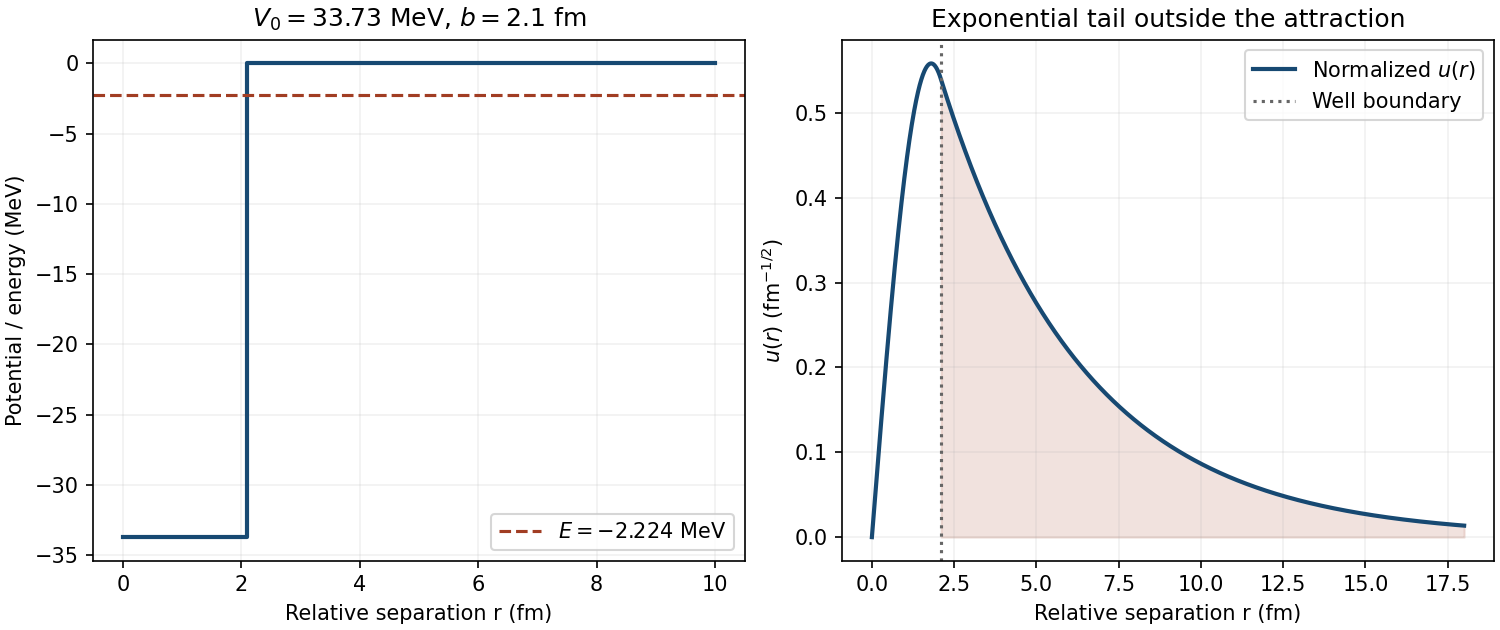
A weakly bound radial state extends beyond the finite nuclear well
. Original calculation from the stated masses, radius and binding. The reduced radial function is normalized with and matches its derivative at the well edge. The central-well model omits the tensor-induced D component. Details.
New to topics? Read the docs here!