The reduced mass is the effective mass for the two-particle relative coordinate of two bodies with constant positive masses :Both bodies can respond to their mutual force, so their relative acceleration is greater than if one were fixed. Consequently . This explains why using either individual mass, or their sum, generally gives the wrong internal oscillation rate. The same reduced mass describes a two-body problem, a free two-mass spring, and the approximate molecular vibration of a diatomic molecule.[ref]
Newtonian Dynamics by Richard Fitzpatrick. Reduced Mass, equations 322–328: equal-opposite forces, relative acceleration and reduced mass
For equal masses , . Two bodies therefore have : in their stationary centre of mass frame a relative speed means individual speeds and total kinetic energy . With and , instead . At the same relative speed, the individual speeds are and , and the total kinetic energy is . These are calculations for stipulated masses and velocities.
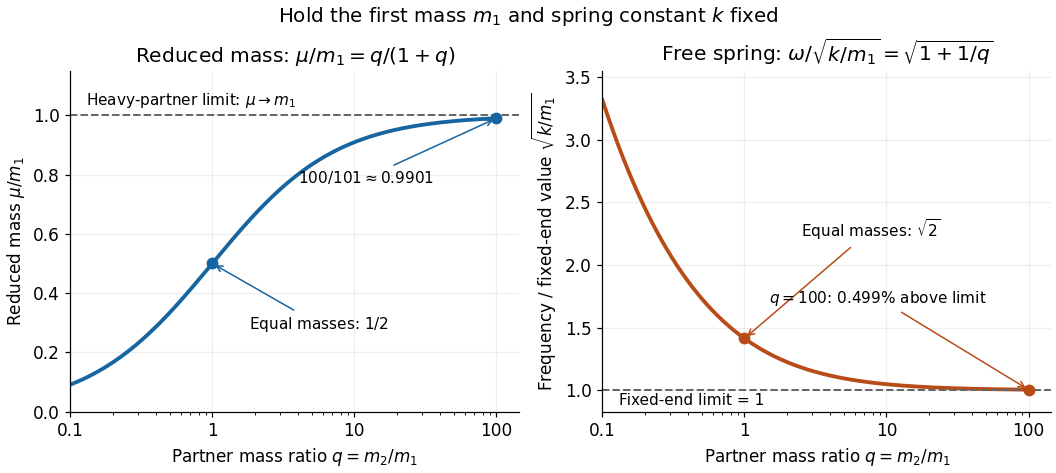
For fixed and , . The heavy-partner limit gives from below; the relative error incurred by replacing with is . At this is . Treating the heavy body as fixed is thus a controlled approximation to internal motion, rather than an exact consequence of its being heavier.
Choose positions in one inertial frame and let . The centre of mass and two-particle relative coordinate areThe lighter body is farther from the centre of mass. Reconstructing both positions from these equations is part of solving the two-body problem; alone describes their separation, not either body's laboratory position.[ref]
Newtonian Dynamics by Richard Fitzpatrick. Reduced Mass, equations 324–326: centre and reconstruction of both particle positions
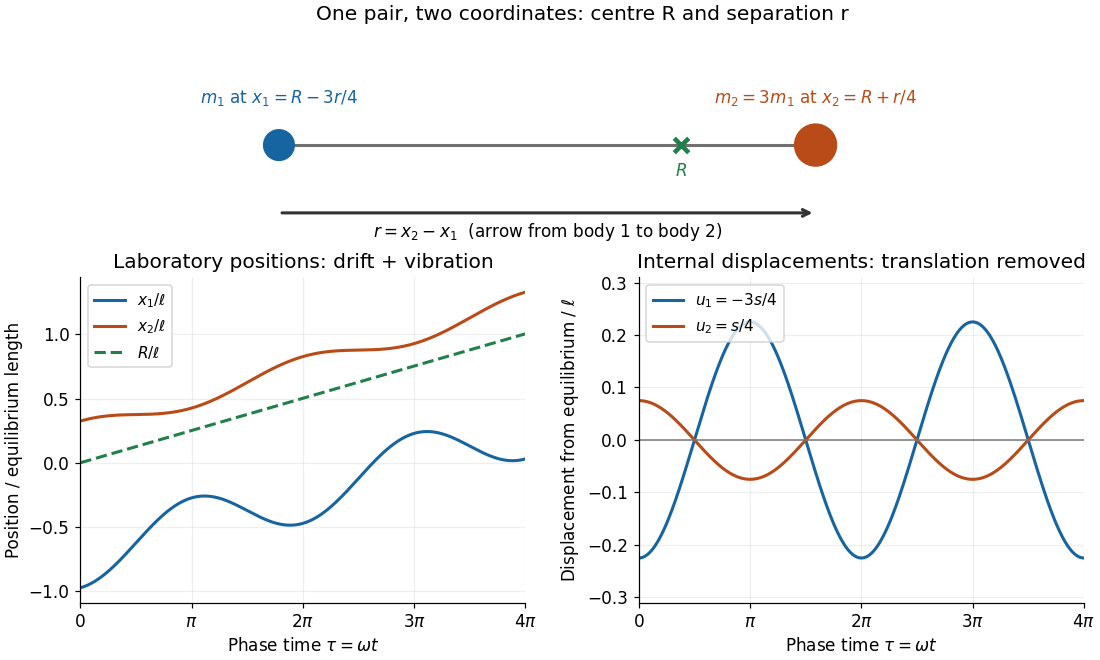
Centre of mass translation and internal two-particle relative coordinate for a pair with mass ratio three
. Original illustrative free two-mass spring model, with , equilibrium separation , relative extension , , and . The right plot subtracts both the translating centre of mass and each body's equilibrium offset. It shows internal displacements, not full distances from the centre of mass. Details.Substitute the reconstructed velocities into the kinetic energy. The result is the exact two-particle instance of kinetic-energy decomposition about the centre of mass:The mixed dot product has coefficient ; the coefficient of is . This algebra needs constant positive masses but no particular force law. In the stationary centre of mass frame, the fraction of internal kinetic energy carried by body 1 is , and by body 2 is : the lighter body carries more.
For a closed pair with no external forces, write for the force on body 2 and for that on body 1, as required by Newton's third law. Adding and subtracting their Newton's second law equations yieldsThus the centre of mass moves uniformly while the two-particle relative coordinate behaves like one body of reduced mass. Equal-opposite internal forces suffice for these equations. For an internal central force, with , the internal torque vanishes and conservation of angular momentum gives constant . If the central force comes from a time-independent potential energy , then and the internal mechanical energy is conserved. The kinetic energy split alone does not establish either conservation law.
Take two point masses joined by a massless spring of spring constant and equilibrium length . Assume one-dimensional motion along the spring, no external force, no damping, and an extension satisfying Hooke's law; keep . For a real spring this is a model within its elastic range. Its potential energy is , soHere is angular frequency and is frequency. Choose so the model bodies do not cross. The internal normal mode has displacements and about equilibrium offsets from the centre of mass; its amplitude ratio is . The other normal mode is collective translation with zero frequency and no spring extension. This free pair has different boundary conditions from normal modes of two equal masses between three springs.
For and two masses, and . Replacing the second mass by gives and . Fixing the second endpoint instead would give : the free heavy partner still moves. The free pair's angular frequency exceeds that fixed-end limit by the factor , about at .
Near a stable equilibrium bond length , a Taylor expansion of a diatomic molecule's potential energy gives , with . Treat the internal stretch as a harmonic oscillator of reduced mass, initially omitting molecular rotation. If replacing an isotope leaves this local potential energy curvature unchanged, thenHere is the speed of light and a spectroscopic wavenumber; use consistent length units for and . The quantum harmonic oscillator gives adjacent energy eigenvalues separated by , with the Planck constant. Consequently a vibrational photon absorption can probe the same frequency scale, subject to electric-dipole selection rules.
For an explicitly approximate isotope example, assign the atomic masses of , , , and the mass-number values , respectively, with the unified atomic mass unit. These are stipulated approximations to individual atomic masses, not measured masses of molecules or natural-abundance averages. They giveThe symbol means deuterium, . Doubling the light partner's approximate atomic mass therefore produces a large predicted shift, whereas changing the already heavy chlorine partner by two mass units produces a much smaller one. A quantitative comparison with infrared spectroscopy requires actual isotope-specific atomic masses, fitted band parameters, and uncertainties, rather than identifying any arbitrary peak with .
An actual infrared spectroscopy route is to compare gaseous hydrogen chloride containing ordinary hydrogen with its deuterium counterpart. A documented teaching experiment uses a stopcock-equipped gas cell with potassium bromide windows and a Nicolet Avatar instrument for Fourier transform spectroscopy. A nitrogen-purged flask and drying tube supply the mixture; the sample also contains sulfur dioxide. An empty sample-chamber background precedes the filled-cell scan. The absorbance trace and peak-picked spectroscopic wavenumbers are the readout. The analysis assigns and indexes and transitions separately and propagates transition uncertainties. The instructions distinguish resolvable chlorine isotope peaks from adequate precision for the intended parameter analysis. [ref]
Vibrational-Rotational Spectroscopy of HCl by James M. McCormick. McCormick, Introduction; Experimental, Laboratory Component, Figures 1–2 and background/peak-picking paragraphs; Analysis and Discussion, first three paragraphs
A separate published teaching dataset reports a Nicolet Nexus 670 instrument, a gas cell at , and chlorine isotope peaks resolved to baseline. These apparatus details describe that dataset, not the preceding experiment. [ref]
HCl and DCl IR absorption spectra by Jonathan Gutow. Gutow, HCl and DCl IR absorption spectra, dataset description: instrument, path length, pressure and resolved chlorine isotope peaks
The inference connects several models. Fit correctly assigned transitions to separate molecular rotation from molecular vibration, then compare the inferred vibrational scales using isotope scaling of diatomic vibration. Agreement supports the approximate separation between a nearly unchanged chemical bond stiffness and a changed nuclear mass. It does not make a real molecule an exact classical spring: anharmonicity shifts the fundamental transition away from the local harmonic oscillator scale, and coupling to molecular rotation shifts individual lines.
For an independent test, calculate the reduced masses from the specified isotopes and compare the inferred values . Agreement within uncertainty tests the common-curvature assumption; choosing separate values just to fit each frequency would not test it. The documented background addresses instrument and ambient contributions, but does not by itself subtract window absorption, identify contaminating species, or calibrate the spectroscopic wavenumber scale. Those require separate controls. Finite spectral resolution, blended peaks, incorrect isotope assignments, and departure from the harmonic approximation near a potential minimum limit the comparison. No numerical measured line positions are assumed here.


