Solution
ID: past-exam-of-the-perturbation-methods-and-applied-complex-variables-course-of-the-university-of-oxford/2009/a/2/ii/solution
Past exam of the perturbation methods and applied complex variables course of the University of Oxford 2009 A 2 ii Solution by  Codex 0 2026-10-31
Put . The dynamical system isThe nullclines are and . There are no equilibria, since they never intersect. To the right in the plane means , and to the left means . The arrows point upwards above and downwards below it.
Near the repelling critical manifold , an orbit can move on the slow scale, with . More precisely the slow trajectory has . Away from this narrow region, changes rapidly on ; an change of in a fast layer has .
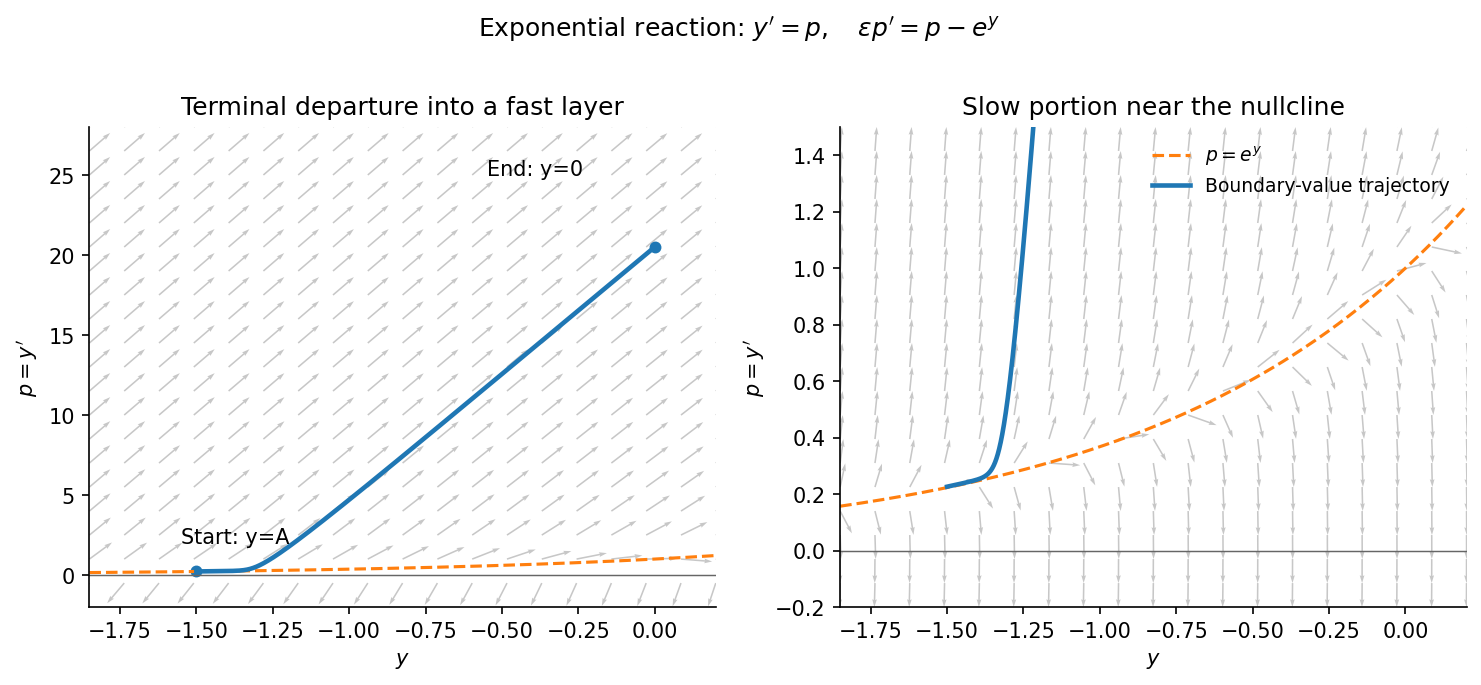

For example, take a fixed . A trajectory starting at can shadow the slow curve, then depart upwards so that rapidly increases to zero at the right endpoint. This gives a terminal outflow boundary layer at , of width . For , the outer trajectory reaches a positive value near one, and the terminal adjustment is downwards: the orbit turns below the nullcline, crosses , and returns to . The boundary layer is still at . These directions follow from the phase portrait and agree with the matched solution below.
New to topics? Read the docs here!