Solution
ID: past-exam-of-the-physics-1-paper-of-the-university-of-oxford/2015/8/d/solution
Past exam of the physics 1 paper of the University of Oxford 2015 8 d Solution by  Codex 0 2026-10-25
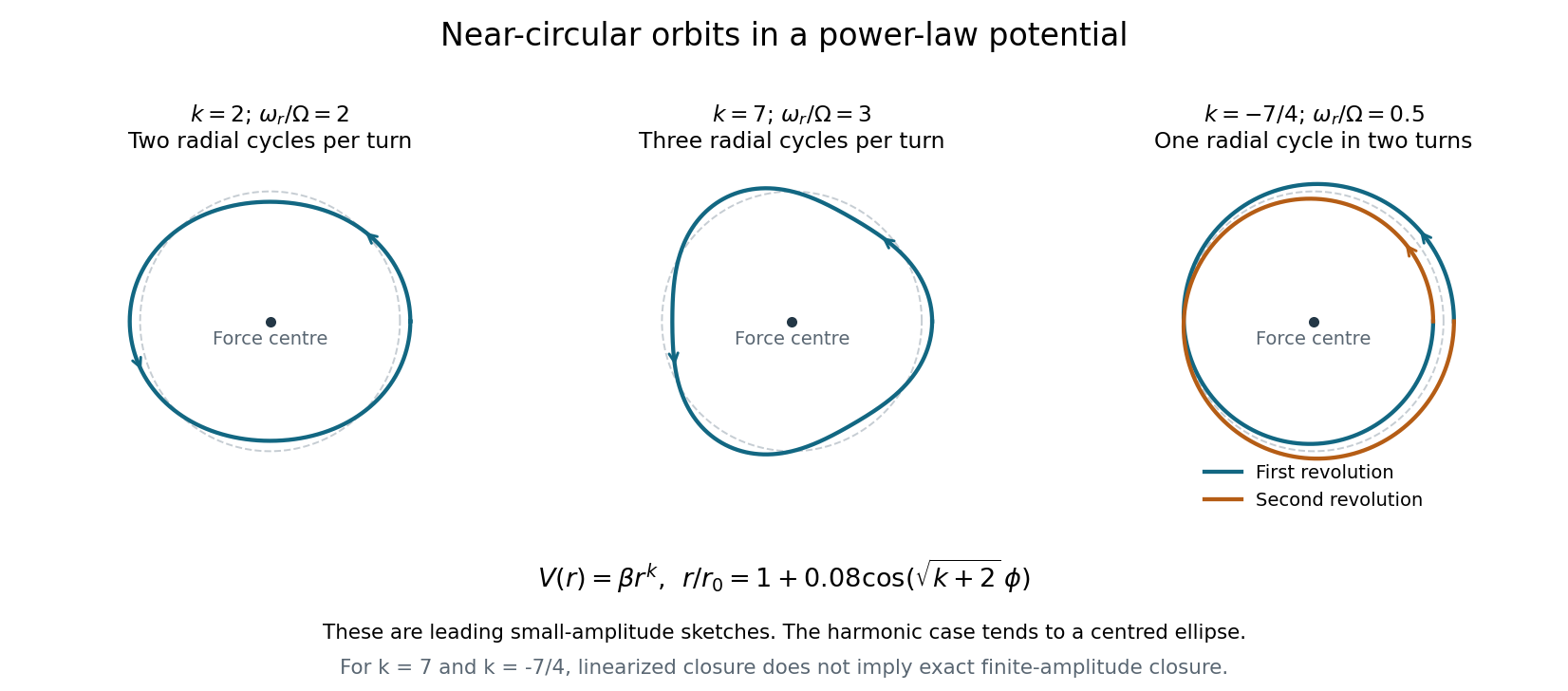
The two positive powers below require ; the negative power requires , so that the force is attractive. To leading order, . The azimuthal advance from one radial maximum to the next isFor , : there are two radial oscillations per revolution. The isotropic harmonic oscillator has orbits that are exact ellipses centred on the force centre, and the perturbed circle is such an ellipse.
For , : the leading perturbation has three radial lobes per revolution, with consecutive radial maxima separated by . Its small-amplitude sketch is a rounded three-lobed orbit.
For , : the radius completes one oscillation while the body makes two revolutions. The leading curve closes after , with a double-wound, generally self-crossing shape; the nearest and furthest points occur in the same spatial direction one revolution apart.
The rational ratios for and describe closure of the linearized near-circular curves. They do not imply that every finite-amplitude orbit closes exactly: higher-order changes in the radial-to-orbital frequency ratio generally produce apsidal precession. Bertrand's theorem identifies the harmonic potential and the Kepler potential as the exceptional attractive central potentials with all nearby bounded orbits closed.

New to topics? Read the docs here!