Solution
ID: past-exam-of-the-physics-2-paper-of-the-university-of-oxford/2017/11/b/solution
Past exam of the physics 2 paper of the University of Oxford 2017 11 b Solution by  Codex 0 2026-10-25
The original diagram places in parallel with the inductor; connects their common node to the source only when the switch is in position 2. Let be their shared voltage and the downward inductor electric current. Since and a finite voltage cannot change it instantaneously, the inductor initially behaves as an open branch. ThusAt long times, an ideal inductor carrying constant electric current has , shorting . Therefore and .
For the full transient, Kirchhoff's current law gives with . Equivalently, the source seen by the inductor has the Thévenin equivalentSolving givesThe relevant resistance is the parallel combination with the ideal voltage source suppressed, not and not alone.
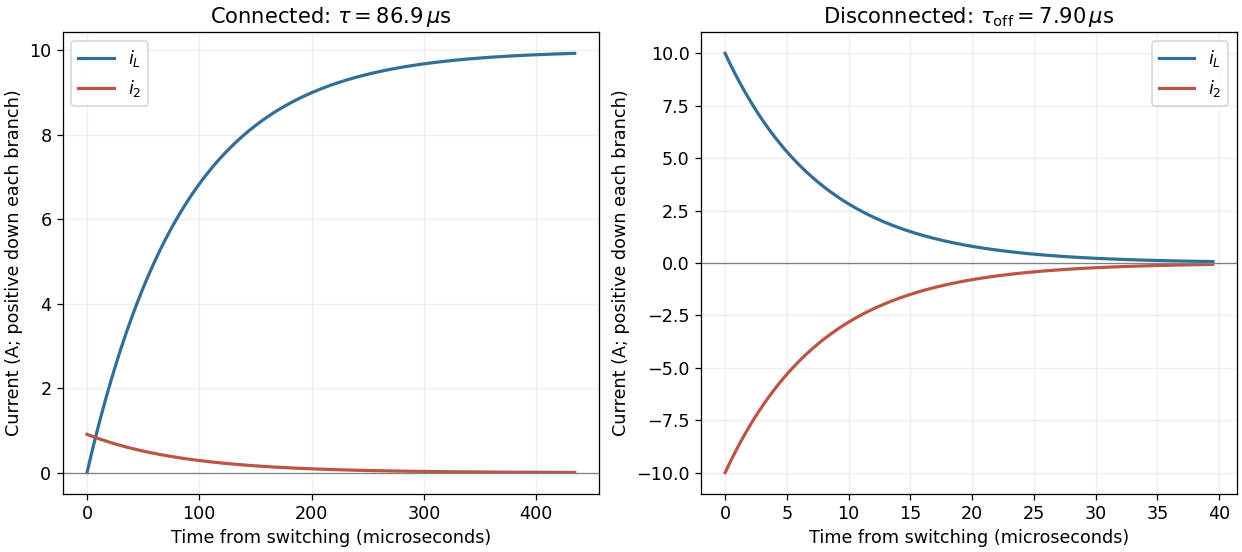
Current redistribution when the solenoid is connected and disconnected
. The two panels use their own time origins. On connection the inductor current grows while the parallel-resistor current decays. On disconnection both branches carry equal and opposite currents as stored magnetic energy dissipates. Details.
New to topics? Read the docs here!