An inductor is an electrical circuit component designed to provide self-inductance, often a coil such as a solenoid. An ideal linear inductor has constant and zero electrical resistance. Its stored magnetic energy, with zero chosen at zero electric current, isFor self-inductance and electric current , this gives . Unlike Joule heating, ideal storage is recoverable: the inductor can return energy to an electrical circuit when its electric current decreases. [ref].
The short derivation uses the terminal convention in self-inductance. The power absorbed by an ideal inductor isStarting from zero electric current, the integral of this power givesPositive increases stored magnetic energy; negative returns energy. At constant electric current in the example, and induced electromotive force is zero, but still resides in the magnetic field. The battery in the steady RL circuit supplies Joule heating in the electrical resistance, rather than further increasing the inductor's magnetic energy.
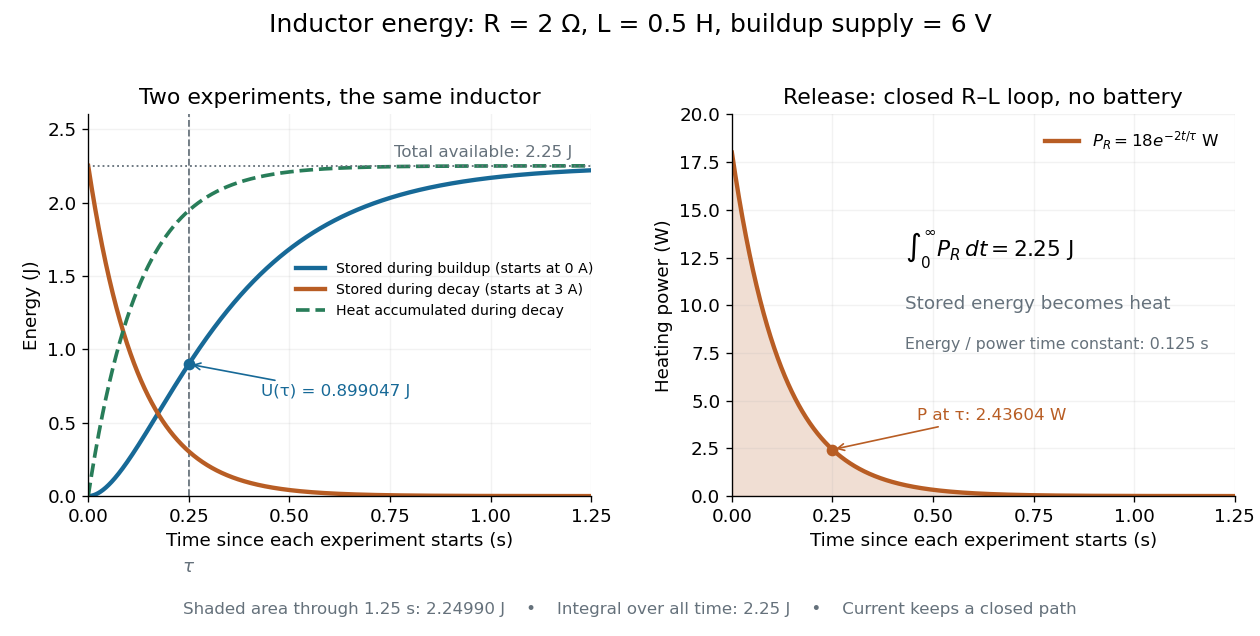
During the closed-loop release in RL circuit, stored magnetic energy plus accumulated Joule heating stays . A real coil also has electrical resistance, so its Joule heating must be included separately from ideal inductor storage. The constant- formulas assume a fixed linear magnetic response.
Articles by others on the same topic

An inductor is a passive electrical component that stores energy in a magnetic field when an electric current passes through it. It typically consists of a coil of wire wound around a core, which can be made of air, iron, or other materials. The key properties of an inductor include: 1. **Inductance (L)**: This is the measure of an inductor's ability to store energy in the magnetic field, typically measured in henries (H).


It resists to change in electric current. Well seen at: Video "LC circuit by Eugene Khutoryansky (2016)".