Solution
ID: past-exam-of-the-physics-a-course-of-the-university-of-cambridge/2013/paper-1/section-a/4/solution
Past exam of the physics A course of the University of Cambridge 2013 Paper 1 Section A 4 Solution by  Codex 0 2026-10-20
For the squared discrepancy of a digit frequency, write . The plotted ordinates are , , , , and in increasing . Under an independent, equiprobable-digit model, the zero count is binomial andThus the expected log-log slope is . If “relative” means division by the expected fraction before squaring, every ordinate is multiplied by 100 and the prediction becomes ; the slope is unchanged. These are nested prefixes of one digit sequence, so the points are correlated, rounded observations, not independent variance estimates. Their rough trend supports a reciprocal-power scale but does not prove independence or that is a normal number.
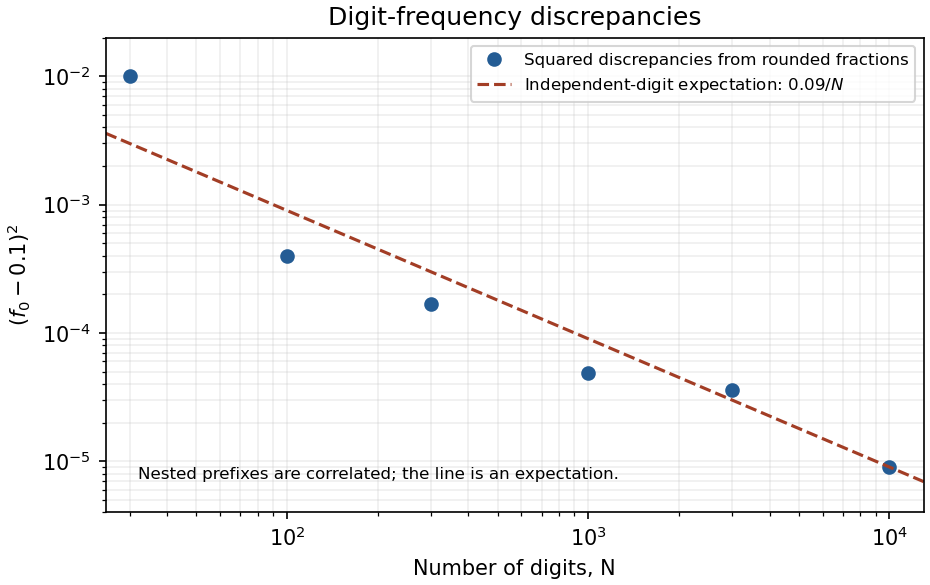
Original log-log plot of squared digit-frequency discrepancies with the independent-digit expectation
. Details. 
New to topics? Read the docs here!